CCPA and State Privacy Laws Guide: California, Virginia, Colorado, and Multi-State Compliance (2024-2026)
schema: | { “@context”: “https://schema.org”, “@graph”: [ { “@type”: “Article”, “headline”: “CCPA and State Privacy Laws Guide: California, Virginia, Colorado, and Multi-State Compliance (2024-2026)”, “description”: “Comprehensive guide to state privacy laws covering CCPA/CPRA, Virginia, Colorado, Connecticut, Utah, and other states, with implementation guidance for multi-state compliance and enforcement preparation.”, “image”: “https://bato.com.np/assets/images/ccpa-state-privacy.jpg”, “datePublished”: “2025-01-22”, “dateModified”: “2026-02-21”, “author”: { “@type”: “Person”, “name”: “Sarah Mitchell” }, “publisher”: { “@type”: “Organization”, “name”: “BATO - Business Audit & Tax Organization”, “logo”: { “@type”: “ImageObject”, “url”: “https://bato.com.np/assets/images/logo.png” } } } ] }
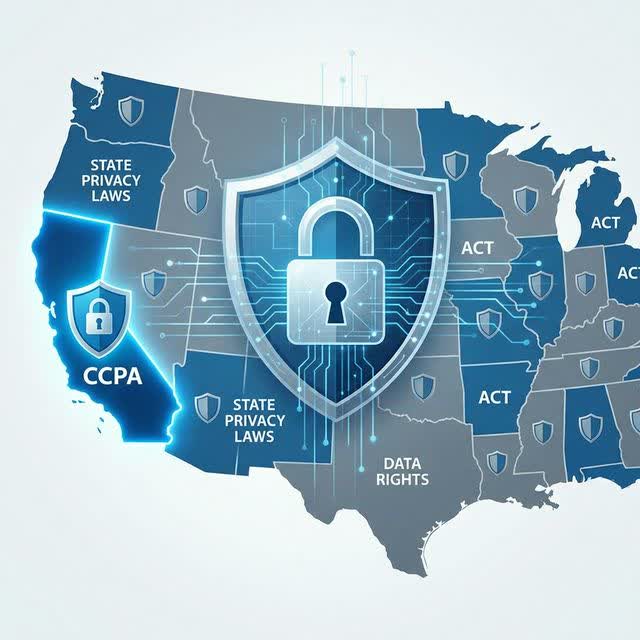
State privacy laws are rapidly proliferating and creating complex compliance obligations. This guide covers CCPA, CPRA, and other state laws with multi-state compliance strategies.
- State Privacy Law Landscape Overview
- California Consumer Privacy Rights Act (CPRA)
- CPRA Business Obligations
- Other State Privacy Laws
- Multi-State Compliance Strategy
- Privacy Regulatory Enforcement
- Privacy Program Implementation
- Conclusion
- Resources
State Privacy Law Landscape Overview
The Evolution of State Privacy Laws
Timeline:
2018: CCPA Enacted (California) - First comprehensive state privacy law
2020: CCPA Effective (Jan 1) - Major compliance deadline, many unclear provisions
2021: CPRA Approved (California ballot) - More stringent, new definitions
2023: CPRA Effective (Jan 1) - Replaced CCPA, California Privacy Protection Agency (CPPA)
2023-2024: Wave of state laws enacted
2024-2026: Regional enactments and enforcement expansion

Current State of Laws (2024-2026):

Fully Effective Laws:
- California CPRA (2023-present)
- Virginia VCDPA (2023-present)
- Colorado CPA (2023-present)
- Connecticut CTDPA (2024-present)
- Utah UCPA (2024-present)

Laws Coming Soon:
- Oregon TPA (effective 2024)
- Montana MTDPA (effective 2025)
- New Hampshire NHDPA (effective 2025)
- Nearly every state considering legislation

Trend: Moving toward baseline privacy requirements across all states
Companies must assume multi-state compliance mandatory (not optional)
Classification: Three Regional Approaches
California Approach (CPRA - Strictest):
Defines "personal information" broadly:
- Information identifying/describing consumer
- Identifiers, commercial information, biometrics
- Internet activity, geolocation, health information
- Inferences drawn from consumer behavior
- Genetic, sex life, gender information

Consumer Rights (8 core rights):
✓ Right to know what data is collected
✓ Right to delete data
✓ Right to correct inaccurate data
✓ Right to opt-out of sale
✓ Right to opt-out of sharing
✓ Right to limit use of sensitive personal information
✓ Right to data portability
✓ Right to non-discrimination for exercising rights

Exemptions (carve-outs):
- HIPAA-regulated entities (some)
- GLBA-regulated entities (some)
- Compliance with other laws (precedence)
- Employee data (partial exemption)
- B2B data (limited in some circumstances)

Enforcement:
- California Attorney General
- District Attorneys
- Consumer right to sue (private right of action)
- Damages: $100-$750 per consumer per incident

CPRA Additions (vs. CCPA):
- Sensitive personal information category
- Opt-out of "sharing" (vs. just "sale")
- Right to correct
- Right to limit use of sensitive info
- California Privacy Protection Agency created (enforcement)
Virginia/Colorado/Connecticut Approach (Moderate):
More narrowly defined personal information:
- Identified/identifiable information
- Less expansive than California
- Excludes some categories California includes

Consumer Rights (4-5 core rights typically):
✓ Right to know
✓ Right to delete
✓ Right to correct (some states)
✓ Right to data portability
✓ Right to opt-out of profiling/automated decision-making

Examples:
Virginia VCDPA (4 rights):
- Right to confirm, access, delete personal data
- Right to correct inaccurate data
- Right to obtain data portability
- Right to opt-out of processing for profiling/targeted advertising

Colorado CPA (4 rights):
- Right to know what personal data is collected
- Right to delete personal data
- Right to correct personal data
- Right to data portability

Connecticut CTDPA (5 rights):
- Right to know
- Right to delete
- Right to correct
- Right to data portability
- Right to opt-out of targeted advertising

Enforcement:
- State Attorney General only (no private right of action)
- Enforcement typically after 2024-2025
- Compliance deadlines vary (usually 1-2 years after effective date)

Compliance Requirements:
- Simpler than CCPA/CPRA (fewer rights, narrower definitions)
- Fewer exemptions (generally apply to all companies)
- Multi-state approach easier (middle-ground compliance)
Emerging Approach (Florida, Kansas, etc.):
Newest laws (2024-2025):
- Simplified definitions
- Core rights (know, delete, portability)
- Limited enforcement (AG only, typically)
- Longer compliance timeframes
- Aligned with Virginia/Colorado model

Trend: Moving away from California's strict model
Easier compliance due to narrower scope
California Consumer Privacy Rights Act (CPRA)
Effective Date and Applicability
CPRA Effective 2023 (Jan 1):
Applies to:
- For-profit entities collecting/processing California consumer data
- Annual gross revenues >$25 million, OR
- Buy, receive for commercial purposes, sell/share data of 100K+
  consumers/households, OR
- Derive 50%+ revenue from selling/sharing consumer data

Jurisdiction:
- Any business serving California residents (regardless of location)
- Multi-state businesses: Must comply even if not headquartered in CA
- Even if minimal footprint in California

Example:
Tech company in New York
- Website accessible to California residents
- Serves California customers
- Collects data from California users
- Must comply with CPRA (regardless of NY location)

Practical impact:
- CPRA likely applies to most significant companies
- De minimis exemptions rare
- Multi-state companies: Usually apply CPRA standard (safest)
Consumer Rights Under CPRA
Right to Know:
Consumer right: Know what personal data is collected

Company obligations:
- Disclose what data is collected
- Categories of data
- Purposes of collection
- Sources of data
- Who has access to data
- Retention policies

Implementation:
- Privacy policy clearly states
- Specific to different contexts (website, app, in-store, etc.)
- Available and accessible (not buried)
- Required responses within 45 days (extendable 45 days)

Right to Know Request Process:
1. Consumer submits request (online, mail, phone)
2. Company verifies identity (reasonable verification)
3. Company gathers information (what CA has on consumer)
4. Compiles response (clear, organized format)
5. Delivers within 45 days (or extends +45 days)

Categories to disclose:
- Identifiers (name, SSN, account number, IP address, etc.)
- Commercial information (purchase history, transactions, etc.)
- Biometric information (if collected)
- Internet activity (browsing history, clicks, etc.)
- Geolocation (precise location tracking)
- Inferences (profiles created about consumer)
- Sensitive personal information:
  * Social Security number/tax information
  * Account passwords
  * Precise geolocation
  * Racial or ethnic origin
  * Religious creed
  * Union membership
  * Mail contents
  * Genetic data
  * Health information
  * Sex life or sexual orientation
  * Citizenship/immigration status
Right to Delete:
Consumer right: Delete personal data

Company obligations:
- Delete data when requested
- Notify service providers/contractors to delete
- May retain data if:
  - Necessary for stated purpose
  - Legal/contractual obligation
  - Fraud/abuse detection
  - Internal analytical use
  - Comply with other laws

Exceptions (can refuse deletion):
✗ Data necessary for original transaction
✗ Fraud prevention
✗ Comply with law
✗ Exercise free speech rights
✗ Maintain integrity of scientific research
✗ Comply with CCPA if triggering additional compliance needs

Implementation:
- Process delete requests within 45 days
- Verify identity (reasonable verification)
- Delete from systems (and contractor systems)
- Retain only as required by law
- Document deletion process
- Respond to consumer with confirmation

Example verification:
Low-risk deletion:
- User email address + account number

Higher-risk (requires more verification):
- Sensitive data
- Large volume of data
- May require additional identity verification
Right to Correct:
Consumer right: Correct inaccurate personal data

Company obligations:
- Correct inaccurate data
- Update records across systems
- Notify service providers to correct
- May deny if unreasonable/ongoing/burdensome
  (but must explain)

Examples of correctable data:
✓ Wrong address in customer profile
✓ Misspelled name
✓ Incorrect birth date
✓ Wrong contact information
✓ Incorrect purchase history

Examples of non-correctable/subject to denial:
- Disputed information (subjective judgment)
- Inferences about consumer behavior (even if consumer disagrees)
- Inaccurate inferences (may not be correctable)

Practical challenge:
- Inferences based on historical behavior
- Not "incorrect" if based on actual data
- Consumer may dispute but company may maintain
- Must document reason for denial
Right to Data Portability:
Consumer right: Obtain copy of personal data in portable format

Company obligations:
- Provide data in structured, commonly-used format
- Must be machine-readable (CSV, JSON, etc.)
- Include all categories of personal data
- Deliver within 45 days

Requirements:
- Format must be portable (not proprietary)
- Include all collected data categories
- Can send to consumer or third party (if authorized)
- No cost to consumer
- Cannot withhold data to penalize exercise of rights

Practical implementation:
- Automated export function (self-service best practice)
- Or manual process (staff generates)
- Verify consumer identity
- Include all data classes
- Common format (CSV, JSON, XML)

Example:
- Consumer requests data portability
- Company provides spreadsheet with all data categories
- Includes profile data, purchase history, inferences, etc.
- Consumer can import into other service
Right to Opt-Out of Sale:
Consumer right: Prevent sale of personal data

Definitions:
SALE: Selling, renting, releasing, disclosing, disseminating, making
      available, transferring, or otherwise communicating personal data
      to other business or third party for monetary/valuable consideration

SHARING: Sharing personal data with third parties for cross-context
        behavioral advertising (often free, no money exchanged)

CCPA allowed opt-out of sale only (limited)
CPRA expanded to opt-out of BOTH sale AND sharing

Practical impact:
- "Do Not Sell/Share My Personal Data" link on homepage (required)
- Prominent notice (required by law)
- Easy opt-out mechanism
- Must honor within 45 days
- Cannot retaliate (price increase, service denial as retaliation)

Implementation challenges:
- Determining what constitutes "sale" vs. normal business
  (e.g., data between subsidiaries - is it a sale?)
- Identifying all recipients
- Tracking opt-outs across all platforms
- Privacy ID exchanges (Google Privacy Sandbox, etc.)
- Cookie management and deletion

Consumer opt-out process:
1. Consumer clicks "Do Not Sell/Share My Personal Data"
2. Provides verification (click link, login, etc.)
3. Confirms opt-out election
4. Company disables tracking cookies, ads, etc.
5. Updates within 45 days
6. Responds to consumer confirming opt-out

Data management post opt-out:
- Cannot use for sale/sharing
- Can use data for other purposes
- Service delivery may continue with previously collected data
- New data collection may or may not use original purposes
Right to Limit Use of Sensitive Personal Information:
New right under CPRA (not in CCPA)

Sensitive data categories:
- Social Security/tax ID numbers
- Account passwords
- Precise geolocation
- Racial/ethnic origin, religious creed
- Union membership
- Mail contents
- Genetic data
- Health data (not covered by HIPAA)
- Sex life/sexual orientation information
- Citizenship/immigration status

Consumer right: Limit use of sensitive information to:
✓ Services/features explicitly requested
✓ Preventing fraud
✓ Complying with law
✓ Other disclosed/obvious uses

NOT permitted (unless consumer opts in):
✗ Selling/sharing sensitive data
✗ Profiling (targeted advertising based on sensitive)
✗ Cross-context behavioral advertising
✗ Using for any purpose other than stated above

Practical challenges:
- Health information not HIPAA (personal wellness apps)
- Precise geolocation from mobile apps
- Inferences about race/ethnicity
- Determining what is "sensitive"
- Need opt-in for most uses (burden on company)

Implementation:
- Identify sensitive data in systems
- Build technical controls (separate processing)
- Update privacy notices
- Implement opt-in mechanisms
- Training on sensitive data handling
CPRA Business Obligations
Privacy by Design and Data Minimization
Privacy by Design:
CPRA requirement: Build privacy into systems, not add after facto

Practical steps:
1. Data inventory (what do we collect, why)
2. Minimize collection (collect only necessary)
3. Access controls (limit employee access)
4. Encryption (data at rest and in transit)
5. Retention limits (delete when no longer needed)
6. Risk assessment (privacy impact assessment)
7. Testing (security audits, penetration testing)
8. Training (employees understand privacy requirements)

Data Minimization:
- Collect only what is necessary
- Delete when no longer needed
- Disable collection when possible
- Granular consent (separate for different purposes)

Example:
Mobile app collecting health data
✓ Collect only data necessary for app function
✓ Allow users to disable GPS when not needed
✓ Delete data after specified retention
✓ Don't correlate health data with advertising profile
✓ Separate systems for different purposes
Service Provider Obligations:
Service providers must:
- Process data only per contract
- Implement reasonable safeguards
- Assist with consumer rights requests
- Notify company of breaches
- Delete data when contract ends
- Not combine with other data (with exceptions)
- Not retain/use for own purposes

Service Provider vs. Third Party:
Service provider: Contractor (limited use per contract)
Third party: Separate entity (own use)

Different rights apply depending on classification
Consent and Opt-In Requirements
Distinctions Between Opt-In and Opt-Out:
Opt-In (Affirmative Consent):
- Consumer must actively agree
- Default is NO (must get permission)
- Used for sale/sharing under CPRA
- Used for sensitive personal information use
- Higher bar for companies

Scenarios requiring opt-in:
- Sale of personal data
- Sharing for cross-context behavioral advertising
- Use of sensitive personal information
- Some new uses not disclosed originally
- Processing genetic data

Opt-Out (Right to Refuse):
- Default is YES (can proceed)
- Consumer can disable
- Like "Do Not Call" registry
- Used for known cookie tracking

Scenarios using opt-out:
- Cookies and tracking (with privacy policy)
- Uses disclosed in privacy policy
- Non-sale/sharing uses

Business impact:
- Opt-in requirement reduces revenue streams
- Opt-out allows more marketing
- Companies must evaluate consent model
- Higher friction with opt-in vs. opt-out
Automated Decision-Making
CPRA Requirements:
Automated decision-making: Using algorithms/AI to make decisions
about consumers (eligibility for credit, employment, ads targeting, etc.)

Consumer rights:
✓ Right to know about automated decision-making
✓ Right to opt-out of profiling
✓ Right to human review of significant decisions
✓ Right to challenge decision

Company obligations:
- Disclose use of automated decision-making
- Explain logic/rationale
- Allow opt-out (where feasible)
- Provide human review option
- Regular audits of systems (discriminatory impact)

"Profiling" definition: Automated analysis of consumer characteristics,
preferences, interests to predict or profile consumer behavior

Right to opt-out of profiling:
- Cannot target advertising based on profile
- Cannot make significant decisions (credit, employment, etc.)
  based solely on profiling
- Can still use profiling information for service improvement

Example:
Advertiser using AI to target ads:
- Identifies "likely college students" using profiling
- Targets ads for college services
- Consumer right to know about profiling
- Consumer right to opt-out
- Company must honor opt-out (no targeted ads to this consumer)

Example - Discriminatory impact:
- AI system denies credit to consumers in certain zip codes
- Actual impact is racial discrimination (though not intentional)
- CPRA requires audits (must identify)
- Must remediate (retrain model, adjust, etc.)
Other State Privacy Laws
Virginia Consumer Data Protection Act (VCDPA)
Applicability:
Effective: Jan 1, 2023

Applies to:
- For-profit entities
- Collecting/processing Virginia consumer data
- Annual revenue >$100M in prior year OR
- Collecting data from 100k+ Virginia residents/households OR
- Deriving 50%+ revenue from selling/sharing consumer data

Narrower scope than CPRA:
- Higher revenue threshold ($100M vs. $25M)
- Only applies to largest entities initially
- May expand with amendments

Consumer Rights (4 rights):
1. Right to confirm, access, delete personal data
2. Right to correct inaccurate personal data
3. Right to data portability
4. Right to opt-out of targeted advertising/profiling

Different from CPRA:
X No right to opt-out of general "sale" (only marketing)
X No sensitive personal information category
X No right to limit use of sensitive info
X Narrower definition of covered entities
X More straightforward compliance
Colorado Consumer Privacy Act (CPA)
Effective 2023:
Applies to:
- Business collecting personal data
- Colorado consumers
- $25M+ revenue OR
- Has data on 100k+ Colorado residents OR
- Derives significant revenue from selling/sharing data

Consumer Rights (4 similar to Virginia):
1. Right to know what personal data is collected
2. Right to delete personal data
3. Right to correct personal data
4. Right to data portability
5. Right to opt-out of targeted advertising

Similar to Virginia (vs. California):
- Simpler than CPRA
- No sensitive data category
- Marketing opt-out (not full "sale" opt-out)
- Narrower profiling definition
Connecticut Data Privacy Act (CTDPA)
Effective 2024:
Similar framework to Virginia/Colorado:
- $25M+ revenue threshold
- 5 consumer rights (including right to correct)
- Opt-out of targeted advertising/profiling
- State AG enforcement only
- Similar definition of personal data to Virginia

Timing:
- Companies had until Jan 1, 2025 to comply (18-month window)
Utah Consumer Privacy Act (UCPA)
Effective 2024:
Simplified version of Virginia/Colorado model:
- $25M+ revenue
- 4 consumer rights (narrower):
  1. Right to access
  2. Right to delete
  3. Right to correct
  4. Right to data portability
- Right to opt-out of profiling/automated

Notable carve-outs:
- Exception for B2B data (wider than other states)
- Less regulation of business data collection
Multi-State Compliance Strategy
Determining Applicability
Which Laws Apply:
Determine for each jurisdiction:

Step 1: Revenue threshold
- Are you over threshold ($25M in most states)?
- Some states have $100M+
- Determine total revenue (not just from that state)

Step 2: Consumer base
- Do you serve consumers in that state?
- Website accessible to state residents?
- Product/service marketed to state?
- Even if no office in state

Step 3: Data collection
- Do you collect data from state residents?
- Direct collection (forms, accounts)
- Indirect collection (cookies, analytics)

Step 4: Data processing
- Do you process/use that data?
- Even if collected for one purpose
- Even if minimally used

Practical determination:
Most national companies:
- Operate multi-state (California, Virginia, Colorado, etc.)
- Have revenue >threshold
- Collect from multiple states
- Therefore: Comply with multiple state laws

Strategy:
- Model: "Comply with strictest (California CPRA)"
- Apply CPRA standards to all consumers
- Same privacy policy for all states
- Same technical controls (all states)
- Single approach easier than state-by-state differences
Harmonized Compliance Approach
Building “Privacy Controls Across All Laws”:
Core Privacy Framework applicable to all states:

Consumer Rights Addressed:
✓ Right to Know: Yes (all states require)
✓ Right to Delete: Yes (all states require)
✓ Right to Correct: Yes (most states require)
✓ Right to Data Portability: Yes (all states require)
✓ Right to Opt-Out of Sale/Sharing: Yes (CA, other states)
✓ Right to Opt-Out of Profiling: Yes (most states)

Implementation ensuring multi-state compliance:

1. Privacy Notice
   - Disclose all required information
   - Explain all data collection purposes
   - Explain sharing/selling
   - Include all consumer rights
   - Format accessible and clear

2. Consumer Rights Mechanism
   - Centralized request system
   - Accepts all right types (know, delete, correct, etc.)
   - Implements rights per consumer's state laws
   - Documents responses and timelines

3. Data Collection Controls
   - Consent mechanisms for sensitive data
   - Opt-out of sale/sharing (for all consumers)
   - Cookie consent (for newer laws)
   - Clear opt-in/opt-out options

4. Technical Implementation
   - Data inventory (across all systems)
   - Access controls (minimize exposure)
   - Encryption (data security)
   - Retention policies (delete when appropriate)
   - Audit trails (track access)

5. Vendor Management
   - Service provider agreements (data processing)
   - Business associate agreements (if applicable)
   - Breach notification terms
   - Right to audit
   - Data return/deletion on termination

6. Training and Documentation
   - Privacy training for employees
   - Documentation of compliance measures
   - Incident response procedures
   - Regular compliance audits
Regional Compliance Timelines
2023-2024 Wave (Already effective):
- California CPRA (1/1/2023)
- Virginia VCDPA (1/1/2023)
- Colorado CPA (1/1/2023)
- Connecticut CTDPA (1/1/2024)
- Utah UCPA (1/1/2024)

2024-2025 Wave (Becoming effective):
- Oregon TPA (effective 1/1/2024)
- Florida FCDPA (effective 7/1/2024)
- Montana MTDPA (effective 10/1/2025)
- New Hampshire NHDPA (effective 1/1/2026)
- Texas TDPSA (effective 7/1/2024)

Expected 2025-2026:
- 10+ additional states expected
- Oklahoma, New Mexico, Massachusetts, Illinois, Wisconsin considering

Practical timeline considerations:
- Not all effective simultaneously
- Staggered implementation creates compliance windows
- New laws have 18-24 month implementation windows typically
- Must track statutory deadlines carefully
- Companies usually proactively comply earlier than required

Strategy for emerging laws:
1. When law first passes (24 months before effective date)
   - Begin preparation
   - Audit current systems

2. 18 months before effective date
   - Finalize compliance framework
   - Update privacy notices
   - Implement technical controls

3. 12 months before effective date
   - Complete system implementation
   - Train employees
   - Create documentation

4. Effective date
   - All controls live
   - Begin accepting consumer requests
Privacy Regulatory Enforcement
Federal Trade Commission (FTC) Authority
FTC Section 5 Authority:
FTC (Federal Trade Commission) has broad authority

Unfair or Deceptive Acts or Practices (UDAP):
- Can enforce against companies
- Privacy statements must be accurate (not deceptive)
- Security practices must match representations
- Failure to implement promised safeguards = violation

Recent FTC enforcement trends (2024-2025):

Example 1: False Security Claims
Company promised "military-grade encryption"
Actually used weak encryption
FTC Action: $4.75M settlement

Example 2: Inadequate Data Security
Company suffered multiple breaches
Failed to implement reasonable safeguards
FTC Action: Compliance order requiring:
- Regular security audits
- Employee training
- Multi-factor authentication
- Encryption requirements

Example 3: Unclear Privacy Practices
Privacy notice vague about data sharing
Actually shared with unmentioned third parties
FTC Action: fine + mandatory clear notice

FTC Section 1202(c) Data Security Requirements:
- Must safeguard personal data reasonably
- Safeguards must match sensitivity of data
- Risk-based approach (higher risk = stronger safeguards)
- Incident response plans required
State Attorney General Enforcement
State-Specific Privacy Law Enforcement:
California Privacy Protection Agency (CPPA):
- Created specifically to enforce CPRA
- Enforcement focused (vs. advisory)
- Can impose civil penalties
- Can negotiate settlements
- Investigates complaints and conducts own reviews

California enforcement powers:
- Up to $7,500 per violation (unintentional)
- Up to $5,000 per violation (intentional)
- Apply per consumer per instance
- Example: 100,000 unauthorized disclosures = $500M exposure

Other state enforcement:
- Most states: Attorney General (state law)
- No private right of action (except California)
- Typically investigation after complaint
- Settlements with corrective action plans
- Public settlements (named companies, penalties disclosed)

Recent enforcement examples:

Meta (Facebook):
- Alleged CCPA violations (data sharing)
- Multiple state enforcement
- Settlements totaling millions
- Agreed to strengthen privacy controls

Google:
- Similar enforcement across states
- Privacy practices under scrutiny
- Ongoing investigations
- Significant financial exposed

Amazon:
- Ring camera privacy issues
- Data sharing allegations
- Multi-state enforcement
- Privacy policy updates required
Consumer Private Right of Action
California Only (CCPA/CPRA):
California unique: Consumers can sue (private right of action)

For: Data breaches involving unencrypted or unredacted personal information

Damages:
- Statutory damages: $100-$750 per consumer per incident
- Actual damages: If greater than statutory
- Attorneys' fees: Prevailing party
- Class actions available

This is different from CCPA rights violations:
- Right to know violations = No private right of action
- Right to delete violations = No private right of action
- Data breach right to sue = Private right of action

Impact:
- Exposure for California companies
- 10,000 consumers = $1M-$7.5M potential liability
- Class actions amplify exposure
- Insurance requirements (cyber liability)

Example case:
Retailer suffers breach (10k customers)
Customer sues on behalf of class
Settlement: $756/customer average = $7.56M
+ Attorneys' fees $2M
= Total $9.56M exposure

Defense strategy (to reduce damages):
- Show encryption was used (limits recovery)
- Small breach size
- Mitigation measures taken
- Quick response and notification
- Some damages reductions possible
Privacy Program Implementation
Privacy Policy Requirements
Mandatory Disclosures:
California CPRA requires privacy notice include:

1. Categories of personal information collected
   - Organized by category
   - How collected (directly, inferred, etc.)

2. Purpose of collection
   - Business/commercial purposes
   - Other purposes disclosed

3. Categories of sources
   - Customer directly
   - Online tracking
   - Third parties
   - Data brokers
   - Others

4. Rights of consumers
   - All applicable rights
   - Clear explanation
   - How to exercise

5. Opt-out mechanisms
   - "Do Not Sell/Share My Personal Data" link/button
   - Prominent placement (homepage)
   - Easy to use

6. Categories of recipients
   - Who receives personal data
   - What roles have access
   - Service providers, third parties

7. Retention periods
   - How long data retained
   - Varies by category typically
   - Deletion procedures

8. Sensitive personal information
   - What is collected
   - How used
   - Consumer opt-in requirements

9. Automated decision-making
   - Whether used
   - Profiling disclosure
   - Opt-out rights

10. Contact information
    - Privacy team contact details
    - How to submit rights request

Other State Requirements (Similar):
- Virginia, Colorado, Connecticut, Utah require similar notices
- Some require posting in multiple languages
- Accessible format (for disabled consumers)

Best Practice Privacy Notice:
- Plain language (not legalese)
- Organized by sections
- Easy to navigate
- Link to detailed policies
- Privacy policy, cookie policy, terms of service aligned
Consumer Rights Request Process
Implementing Request Fulfillment:
Required Process:

1. Create submission mechanism
   - Online form (web form, email, portal)
   - Toll-free phone number (California requirement)
   - Mailing address
   - Multiple options required

2. Request receipt
   - Acknowledge request within short period
   - Confirm scope of request
   - Provide timeline

3. Verification procedures
   - Reasonable verification of identity
   - Balance security with accessibility
   - Document verification method
   - Reasonable standards (not onerous)

4. Processing timeline
   - 45 calendar days (most states)
   - Can extend 45 additional days (if complex)
   - Communicate timeline to consumer

5. Response method
   - Deliver in portable format (data requests)
   - Consumer can choose electronic/mail
   - No cost (some exceptions)
   - Secure transmission (sensitive info)

6. Denial procedures (if applicable)
   - Cannot deny access to data consumer may inspect
   - Can deny some deletion requests (see exceptions)
   - Must provide reason
   - Information on how to appeal

7. Documentation and monitoring
   - Track all requests and responses
   - Monitor timelines
   - Document reasons for any denials
   - Maintain records for compliance/defense

SaaS Consumer Rights Platform:
Most companies use software for automation:
- Consumer portal (self-service)
- Request tracking
- Verification tools
- Report generation
- Timeline management

Examples:
- OneTrust
- TrustArc
- Nymity
- Custom solutions some companies build internally
Training and Compliance Monitoring
Organizational Requirements:
Mandatory elements:

1. Employee Privacy Training
   - Annual requirement (most states)
   - Role-specific training:
     * General privacy rules
     * Engineering: Data minimization, retention
     * Customer service: Consumer rights, requests
     * Marketing: Opt-out requirements, consent
   - Completion tracking
   - Refresher training

2. Privacy Impact Assessments (Annual/as needed)
   - Review new data collection
   - Assess privacy risks
   - Document risk mitigation
   - Required before new projects

3. Data Inventories (Regular)
   - Track all data collection points
   - Categories of data
   - Retention periods
   - Sharing practices
   - Deletion processes
   - Update as systems change

4. Vendor Management
   - Contracts with data processors
   - Service provider agreements
   - Data use restrictions
   - Breach notification terms
   - Right to audit
   - Incident response obligations

5. Incident Response Plan
   - Procedures for data breaches
   - Notification timelines
   - Remediation steps
   - Communication strategy
   - External contacts (lawyers, PR)

6. Compliance Audits
   - Internal audits (quarterly/semi-annual)
   - External audits (annual, some companies)
   - Gap assessment
   - Remediation tracking
   - Documentation

7. Consumer Communications
   - Clear privacy notices (accessible)
   - Opt-out mechanisms (functional)
   - Rights request system (working)
   - Periodic updates as laws change
   - Transparency reports (if applicable)
Conclusion
State privacy laws requirement landscape is rapidly evolving. Success requires:
Critical Compliance Factors:
- Understand Applicable Laws
- Determine which states’ laws apply
- Understand each law’s requirements
- Track new laws as enacted
- Build Privacy Program
- Privacy governance structure
- Privacy notice and policies
- Consumer rights mechanisms
- Technical controls
- Data minimization
- Multi-State Approach
- Apply strictest standard (usually CPRA)
- Implement controls for all consumers
- Consistent policies across states
- Reduces complexity
- Consumer Rights Infrastructure
- Request submission mechanisms
- Verification procedures
- Processing capabilities
- Documentation/reporting
- Consider software platforms
- Employee Training
- Annual privacy training
- Role-specific expectations
- Documentation of completion
- Regular refreshers
- Continuous Monitoring
- Privacy impact assessments
- Data inventories
- Vendor management
- Incident response plans
- Regular audits
- Transparency
- Clear privacy notices
- Honest representations
- Actionable consumer rights
- Prompt response to requests
Looking Forward (2024-2026):
- Expect 10+ additional state laws
- Harmonization unlikely (each state unique)
- Federal privacy law possible (but still years away)
- Multi-state approach essential
- Privacy becoming board-level concern
- Budget for ongoing compliance
- Consider privacy-by-design approach
Final Recommendation:
Privacy law compliance is no longer optional or deferrable. Companies should treat privacy as a critical business function with board-level engagement, dedicated resources, and regular investment. The cost of compliance is far lower than the cost of regulatory enforcement, litigation, and reputational damage from breaches or privacy violations.
Resources
- FTC Privacy/Security Guidance: ftc.gov/privacy
- California Attorney General: oag.ca.gov
- California Privacy Protection Agency: cppa.ca.gov
- Virginia VCDPA Text: legis.virginia.gov
- Colorado CPA Text: leg.colorado.gov
- Connecticut CTDPA Text: ct.gov
- Privacy Law Tracking: Chapman Stratton research, Politico Pro
- Privacy Consulting: DPOs (Data Protection Officers), Privacy consultants
- Legal Resources: Privacy lawyers, data protection attorneys
- Industry Groups: Privacy by Default, Industry associations by sector
Related Articles
- CCPA vs GDPR: Key Differences Every Global Business Must Understand
- HIPAA Healthcare Compliance Guide: Privacy, Security, Breach Notification, and Enforcement (2024-2026)
- GDPR Compliance Guide: Data Protection Requirements, Implementation, Fines, and Best Practices (2024-2026)
- Payroll and Wage-Hour Compliance Guide: FLSA, Classification, Overtime, Deductions, and Requirements (2024-2026)
- AML Compliance Guide: Anti-Money Laundering Requirements, KYC, Suspicious Activity Reporting, and Risk Management (2024-2026)