Global VAT Registration Thresholds 2026: A Quick Guide

schema: | { “@context”: “https://schema.org”, “@graph”: [ { “@type”: “Article”, “headline”: “Global VAT Registration Thresholds 2026: A Quick Guide”, “description”: “A country-by-country list of Value Added Tax (VAT) and Goods and Services Tax (GST) registration thresholds for businesses selling internationally.”, “image”: “https://bato.com.np/assets/images/vat-thresholds-cover.jpg”, “datePublished”: “2026-02-18”, “dateModified”: “2026-02-21”, “author”: { “@type”: “Person”, “name”: “Indirect Tax Specialist” }, “publisher”: { “@type”: “Organization”, “name”: “BATO - Business Audit & Tax Organization”, “logo”: { “@type”: “ImageObject”, “url”: “https://bato.com.np/assets/images/logo.png” } } }, { “@type”: “FAQPage”, “mainEntity”: [ { “@type”: “Question”, “name”: “What is the VAT registration threshold for EU distance sales?”, “acceptedAnswer”: { “@type”: “Answer”, “text”: “For B2C distance sales of goods and digital services within the EU, there is a unified threshold of \u20ac10,000. Crossing this requires registration in destination countries or use of the OSS scheme.” } }, { “@type”: “Question”, “name”: “Do non-resident businesses have a VAT threshold?”, “acceptedAnswer”: { “@type”: “Answer”, “text”: “In many jurisdictions, including the UK and most EU states, non-resident businesses have a zero registration threshold, meaning they must register for VAT from their very first taxable sale.” } }, { “@type”: “Question”, “name”: “What happens if I exceed the VAT threshold?”, “acceptedAnswer”: { “@type”: “Answer”, “text”: “Once you exceed the threshold, you are legally required to register with the relevant tax authority, charge VAT on your sales, and file regular VAT returns to avoid penalties.” } } ] } ] }
Selling goods or services globally? Understanding when you must register for VAT/GST is critical to avoiding penalties. This guide gives you the thresholds, explains resident vs. non-resident rules, covers digital services VAT, and explains the EU OSS scheme that simplifies compliance for cross-border sellers.
What is a VAT Registration Threshold?
A VAT registration threshold is the amount of taxable turnover (sales) a business can make in a specific jurisdiction before it is legally required to register for Value Added Tax (VAT), Goods and Services Tax (GST), or equivalent indirect tax — and begin charging it to customers.
Why thresholds matter:
- Below the threshold: you sell without VAT, keeping prices lower for customers
- Above the threshold: mandatory registration, collection, filing, and remittance obligations begin
- Failure to register when required can trigger retroactive tax assessments, penalties, and interest charges
Resident vs. Non-Resident Rules — The Key Distinction
Critical: Many countries apply a zero threshold for non-resident (foreign) businesses. This means a US company making its first sale to a German consumer may owe German VAT immediately, with no registration grace period.
| Business Type | Typical Treatment |
|---|---|
| Domestic / resident | Full threshold applies |
| Non-resident (physical goods) | Zero threshold in most EU countries and UK |
| Non-resident (digital services) | Zero threshold in EU, UK, Australia, Korea, etc. |
| Marketplace (Amazon, Etsy) | Platform typically liable — seller may be exempt |
The EU One-Stop Shop (OSS) — The Big Change Since 2021
Before July 2021, a US seller shipping goods to 10 EU countries needed up to 10 VAT registrations. The EU One-Stop Shop (OSS) consolidated this:
- €10,000 EU-wide threshold for intra-EU B2C distance sales of goods and digital services
- Once crossed: register for OSS in a single EU member state and report all EU sales through one quarterly return
- VAT is then distributed by the OSS country to each destination country
- OSS is optional — but far simpler than registering in every country
Who qualifies for OSS: Any EU-established business, and non-EU businesses with an EU VAT registration, can use the OSS scheme.
VAT / GST Thresholds by Region (2026)
European Union & UK
| Country | Domestic Threshold | Non-Resident Threshold | Rate |
|---|---|---|---|
| United Kingdom | £90,000 | £0 (non-resident) | 20% |
| Germany | €22,000 (small business) | €0 | 19% |
| France | €91,900 (goods) / €36,800 (services) | €0 | 20% |
| Italy | €85,000 (forfettario) | €0 | 22% |
| Spain | None (mandatory from €1) | €0 | 21% |
| Netherlands | None | €0 | 21% |
| Sweden | SEK 80,000 | SEK 0 | 25% |
| Poland | PLN 200,000 | PLN 0 | 23% |
| Ireland | €80,000 (goods) / €40,000 (services) | €0 | 23% |
| Switzerland | CHF 100,000 | CHF 0 | 8.1% |
| Norway | NOK 50,000 | NOK 50,000 | 25% |
| EU distance sales | €10,000 EU-wide | via OSS | varies |
Asia Pacific
| Country | Threshold | Rate |
|---|---|---|
| Australia (GST) | AUD $75,000 | 10% |
| New Zealand (GST) | NZD $60,000 | 15% |
| Singapore (GST) | SGD $1,000,000 | 9% |
| Japan (Consumption Tax) | JPY 10,000,000 (~$67K) | 10% |
| India (GST) | INR 2,000,000 (services) / INR 4,000,000 (goods) | 18% (standard) |
| Malaysia (SST) | MYR 500,000 | 6–8% |
| South Korea | KRW 48,000,000 (~$36K) | 10% |
| Thailand (VAT) | THB 1,800,000 (~$50K) | 7% |
North America
| Jurisdiction | Threshold | Notes |
|---|---|---|
| Canada (GST/HST) | CAD $30,000 | 5% federal + provincial |
| USA (Sales Tax) | No federal VAT | Economic nexus: typically $100K sales or 200 transactions per state |
| Mexico | None | 16% IVA; mandatory from first peso |
Middle East & Africa
| Country | Threshold | Rate |
|---|---|---|
| UAE (VAT) | AED 375,000 (mandatory) / AED 187,500 (voluntary) | 5% |
| Saudi Arabia (VAT) | SAR 375,000 (mandatory) / SAR 187,500 (voluntary) | 15% |
| South Africa (VAT) | ZAR 1,000,000 | 15% |
| Kenya (VAT) | KES 5,000,000 | 16% |
| Nigeria (VAT) | None (mandatory) | 7.5% |
Digital Services VAT: The Non-Resident Trap
If your business sells digital products or services (SaaS, ebooks, streaming, online courses) to consumers globally, you face VAT obligations in virtually every jurisdiction — typically with zero threshold for non-residents:
| Region | Digital Services Rule |
|---|---|
| EU | Register in any EU state or use OSS; charge local VAT rate |
| UK | Register with HMRC MOSS equivalent; 20% VAT |
| Australia | Register if turnover >AUD $75K to Australian consumers |
| Japan | Register if selling to Japanese consumers (no threshold) |
| South Korea | Register with Korean NTS; 10% VAT |
| India | Non-resident digital suppliers must register (18% GST) |
US Sales Tax: Economic Nexus by State
The US has no federal VAT — instead, 45 states + DC levy sales tax with independent rules. Post the South Dakota v. Wayfair Supreme Court decision (2018), all states can require:
Economic nexus thresholds (most common):
- $100,000 in sales to the state, OR
- 200 separate transactions to the state
This applies even if you have no physical presence in that state. A SaaS company based in California with $150K in Texas customer revenue must register, collect Texas sales tax, and file Texas returns.
Compliance Strategy for Cross-Border Sellers
- Map your revenue by country — identify where you’re approaching or exceeding thresholds
- EU sellers: Register for OSS in one EU state; eliminates the need for 27 individual registrations
- Digital businesses: Use automated compliance tools (Avalara, TaxJar, Vertex) to maintain a tax obligation matrix across jurisdictions
- Marketplace sellers: Confirm whether the platform (Amazon, Etsy, App Store) is the deemed supplier — if so, the platform remits VAT and you may not need separate registration
- Annual threshold review: Many thresholds are adjusted annually; build a calendar reminder to review your obligations each January
Tip: Always engage a local indirect tax advisor when entering a new market. Retroactive VAT assessments can be substantial — particularly in the EU where authorities can assess up to 4 years of missed VAT plus penalties of up to 40%.
Related Articles
- International Payroll & Employer of Record (EOR): The Global Hiring Guide
- Tax Loss Harvesting: A Complete Guide to Reducing Your Tax Bill
- Payroll Tax Guide for Small Business Owners (2026)
- Corporate Tax Systems Compared Globally (2026 Guide)
What is a Registration Threshold?
It is the amount of taxable turnover (sales) a business can make in a specific country before it is legally required to register for VAT and start charging it to customers.
Key Distinction: Resident vs. Non-Resident
Warning: Many countries have a zero threshold for non-resident businesses (especially for digital services). This means if you make a single sale, you must register.
Thresholds by Region
Europe (EU)
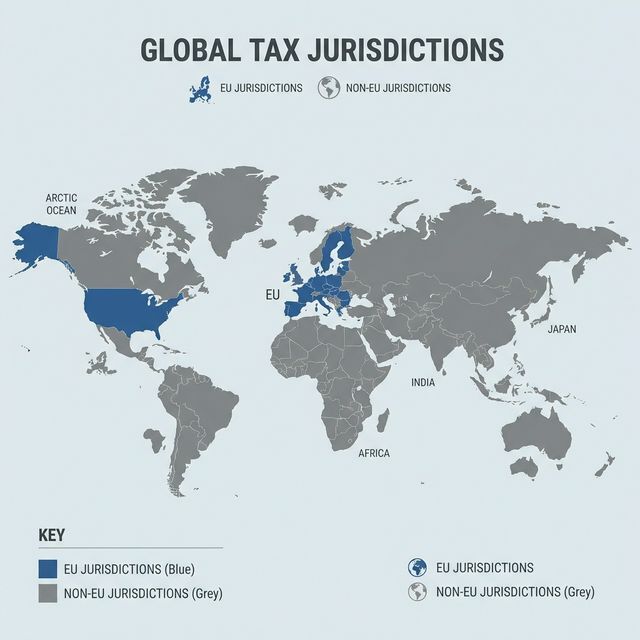
For intra-EU distance sales of goods and B2C digital services, there is a €10,000 EU-wide threshold. Once crossed, you must register in every country you sell to OR use the One-Stop Shop (OSS) scheme.
- UK: £90,000 (Domestic) / £0 (Non-resident)
- Germany: €22,000 (Small business relief)
- France: €91,900 (Goods) / €36,800 (Services)
Asia Pacific
- Australia (GST): AUD $75,000
- Singapore (GST): SGD $1 million
- Japan (Consumption Tax): JPY 10 million
- India (GST): INR 2 million (Services) / 4 million (Goods)
North America
- Canada (GST/HST): CAD $30,000
- USA (Sales Tax): Determined by “Economic Nexus” (typically $100k sales or 200 transactions per state).
Conclusion
Thresholds change frequently. Always consult with a local tax advisor or use an automated compliance solution.