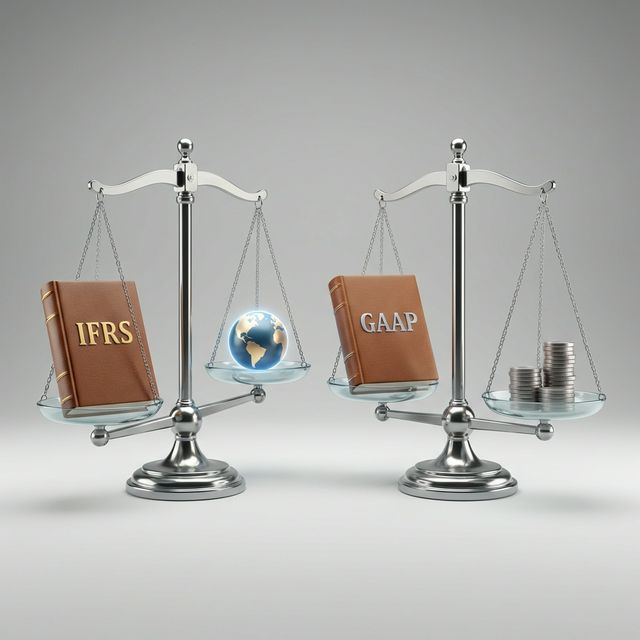
IFRS Explained for Professionals: A Complete Overview

schema: | { “@context”: “https://schema.org”, “@graph”: [ { “@type”: “Article”, “headline”: “IFRS Explained for Professionals: A Complete Overview”, “description”: “A comprehensive guide to International Financial Reporting Standards (IFRS), covering the framework, key standards, and adoption roadmap.”, “image”: “https://bato.com.np/assets/images/ifrs-explained-cover.jpg”, “datePublished”: “2026-02-18”, “dateModified”: “2026-02-21”, “author”: { “@type”: “Person”, “name”: “Technical Accounting Lead” }, “publisher”: { “@type”: “Organization”, “name”: “BATO - Business Audit & Tax Organization”, “logo”: { “@type”: “ImageObject”, “url”: “https://bato.com.np/assets/images/logo.png” } } } ] }
International Financial Reporting Standards (IFRS) are the global language of business — used in over 140 jurisdictions to prepare and present financial statements. This guide gives finance professionals and accountants the complete picture: the conceptual framework, the most impactful individual standards, IFRS vs. US GAAP key differences, and what adoption looks like in practice.
What is IFRS?
IFRS Standards are set by the International Accounting Standards Board (IASB), an independent body based in London. The IASB’s mission is to develop standards that bring transparency, accountability, and efficiency to the global capital markets.
IFRS is principles-based rather than rules-based — it establishes objectives and concepts, then relies on professional judgment for application. This contrasts with US GAAP, which is more prescriptive with specific bright-line rules for most transactions.
Global Adoption Status (2026)
| Status | Jurisdictions |
|---|---|
| Required for listed companies | EU, UK, Australia, Canada, South Africa, Brazil, Hong Kong, Singapore, South Korea, and 130+ others |
| Permitted (not required) | Japan, Switzerland |
| Not adopted | USA (uses US GAAP), though SEC allows foreign private issuers to use IFRS without reconciliation |
| IFRS for SMEs | Adopted in 85+ jurisdictions for non-listed entities |
The IASB Conceptual Framework
The Framework establishes the foundation for standard-setting and financial reporting. It articulates:
Fundamental Qualitative Characteristics
- Relevance — Information must be capable of making a difference in user decisions. Includes materiality: information is material if omitting or misstating it could influence decisions.
- Faithful Representation — Information must be complete, neutral, and free from material error. It doesn’t have to be 100% accurate — it must represent economic phenomena without bias.
Enhancing Qualitative Characteristics (CVTU)
- Comparability: Like items look alike; unlike items look different
- Verifiability: Different knowledgeable observers reach similar conclusions
- Timeliness: Information is available before it loses its capacity to influence decisions
- Understandability: Information is clearly classified and presented
Underlying Assumption
Going concern: Financial statements assume the entity will continue in operation for the foreseeable future. If not, a different basis of preparation is used and disclosed.
The Most Important IFRS Standards
IFRS 9: Financial Instruments
Replaced IAS 39 and introduced three key changes:
- Classification and Measurement: Based on the business model and contractual cash flow characteristics. Financial assets are classified as amortised cost, FVOCI (fair value through OCI), or FVTPL (fair value through profit or loss).
- Impairment — Expected Credit Loss (ECL): Replaced the “incurred loss” model with a forward-looking ECL model. Banks and lenders must provision for expected losses from Day 1 — not just when a loss event occurs. This was a major change for financial institutions.
- Hedge Accounting: Aligned accounting more closely with actual risk management practices, making it easier to apply hedge accounting for economic relationships that previously didn’t qualify.
IFRS 15: Revenue from Contracts with Customers
The unified revenue recognition standard (also mirrored by ASC 606 in US GAAP) uses a 5-step model:
- Identify the contract(s) with a customer
- Identify the performance obligations in the contract
- Determine the transaction price
- Allocate the transaction price to the performance obligations
- Recognize revenue when (or as) each performance obligation is satisfied
Key concepts:
- Variable consideration (bonuses, discounts, returns) must be estimated and constrained
- Contract modifications must be assessed as new contracts or changes to existing ones
- Licences can be point-in-time (right to IP as it exists) or over time (access to IP as it develops)
IFRS 16: Leases
Eliminated the operating lease off-balance sheet treatment for lessees. All leases with terms >12 months (unless low-value asset) must now be:
- Recognized as a right-of-use (ROU) asset on the balance sheet
- Paired with a lease liability for the present value of future payments
Impact: Dramatically increased reported assets and liabilities for airlines, retailers, and any business with significant lease portfolios. EBITDA improves (depreciation replaces rent expense) but net income can decrease in early lease years due to front-loaded interest expense.
Lessor accounting is unchanged under IFRS 16 — still classified as operating or finance leases.
IFRS 17: Insurance Contracts
The most complex standard in recent IASB history. Replaced IFRS 4 from 2023 for all entities issuing insurance contracts. Requires:
- General Measurement Model (GMM): Fulfillment cash flows (best estimate of future cash outflows discounted to present value) + Contractual Service Margin (CSM representing unearned profit)
- Variable Fee Approach (VFA): For contracts where policyholders participate in returns from underlying items
- Premium Allocation Approach (PAA): Simplified method for short-duration contracts (similar to earned premium model)
IFRS 17 fundamentally changed the income statement profile of insurance companies — making profits emerge over the coverage period rather than at inception.
IFRS 3: Business Combinations
All business combinations must be accounted for using the acquisition method:
- Identify the acquirer
- Measure the fair value of identifiable assets acquired and liabilities assumed
- Recognize goodwill (or bargain purchase gain)
Goodwill under IFRS is not amortised — instead it is tested for impairment annually (IAS 36). This contrasts with US GAAP, which recently offered private companies the option to amortize goodwill.
IAS 36: Impairment of Assets
Assets must not be carried at more than their recoverable amount. Recoverable amount = higher of Fair Value Less Costs to Sell (FVLCS) or Value in Use (VIU — discounted cash flow).
IFRS vs. US GAAP: Key Differences
| Topic | IFRS | US GAAP |
|---|---|---|
| Inventory costing | FIFO or weighted average only | FIFO, weighted average, or LIFO |
| Inventory write-down | Reversible if value recovers | Irreversible |
| Development costs | Capitalized when criteria met | Generally expensed |
| Revenue (IFRS 15 vs ASC 606) | Converged — largely identical | Largely identical |
| Lease accounting (IFRS 16 vs ASC 842) | All leases on balance sheet | Operating leases presented differently |
| Goodwill | Not amortized — impairment only | Impairment; amortization option for private companies |
| Revaluation | Allowed for PP&E and intangibles | Not permitted |
| Component depreciation | Required | Not required |
IFRS for SMEs
A self-contained standard for small and medium-sized entities that do not have public accountability. Key simplifications:
- Goodwill and intangibles: amortised over useful life (not impaired)
- No complex financial instrument standards
- Reduced disclosure requirements — approximately 90% fewer than full IFRS
- Reviewed and updated approximately every 3 years by the IASB
Conclusion
Mastering IFRS requires understanding not just the individual standards but the underlying principles-based philosophy. When in doubt, return to the Conceptual Framework: what provides the most relevant faithful representation of the economic reality? That question, applied consistently, is the core of IFRS application.
Related Articles
- IFRS vs GAAP: Key Differences Every Accountant Should Know (2026 Edition)
- IFRS Consolidation Accounting: Equity Method, Control, and Subsidiary Reporting Under International Standards (2026)
- ASC 842 Lease Accounting: A Practical Guide for Finance Teams
- Financial Statement Analysis: How to Read and Interpret Every Line
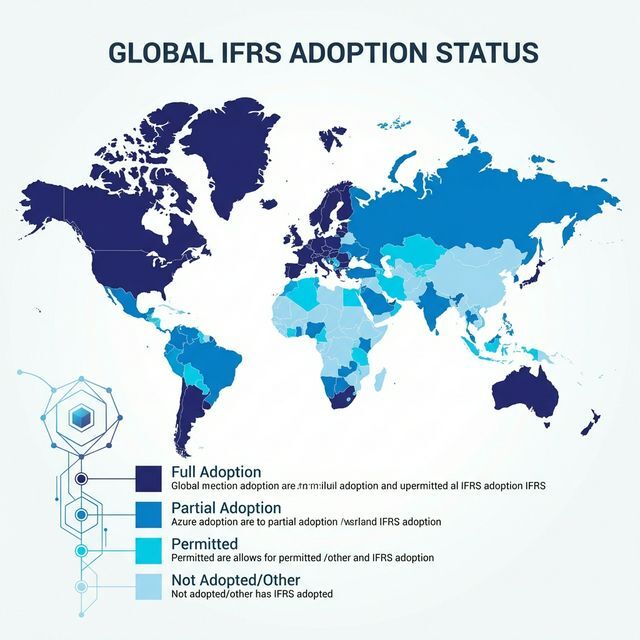
- Required: Over 140 jurisdictions (EU, Australia, Canada, South Africa).
- Permitted: Japan, Switzerland.
- Not Adopted: USA (Uses US GAAP, although convergence projects exist).
The Conceptual Framework
The Framework sets out the fundamental concepts of financial reporting:
Qualitative Characteristics
- Relevance: Information capable of making a difference in decisions.
- Faithful Representation: Complete, neutral, and free from error.
- Comparability, Verifiability, Timeliness, Understandability.
Key Standards Overview
IFRS 9: Financial Instruments
Introduced a logical model for classification and measurement, a single forward-looking ‘expected loss’ impairment model, and a substantially reformed approach to hedge accounting.
IFRS 15: Revenue from Contracts with Customers
Establishes a five-step model for recognizing revenue:
- Identify the contract(s) with a customer.
- Identify the performance obligations.
- Determine the transaction price.
- Allocate the transaction price.
- Recognize revenue when (or as) performance obligations are satisfied.
IFRS 16: Leases
Requires lessees to recognize assets and liabilities for all leases with a term of more than 12 months, unless the underlying asset is of low value.
Impact: This standard significantly increased reported assets and liabilities for companies with extensive leasing activities (e.g., airlines, retailers).
IFRS for SMEs
A self-contained standard tailored for small and medium-sized entities. It simplifies recognition and measurement requirements and reduces disclosure.
Conclusion
Mastering IFRS is crucial for any finance professional operating in a global environment. Understanding the principles, rather than just the rules, is key to correct application.