What is an Internal Audit? A Beginner's Guide to Roles & Process

schema: | { “@context”: “https://schema.org”, “@graph”: [ { “@type”: “Article”, “headline”: “What is an Internal Audit? A Beginner’s Guide to Roles & Process”, “description”: “Understand the basics of internal audit, how it differs from external audit, and why it’s crucial for risk management and compliance.”, “image”: “internal-audit-basics”, “datePublished”: “2026-02-24”, “dateModified”: “2026-02-21”, “author”: { “@type”: “Person”, “name”: “BATO Editorial Team” }, “publisher”: { “@type”: “Organization”, “name”: “BATO - Business Audit & Tax Organization”, “logo”: { “@type”: “ImageObject”, “url”: “https://bato.com.np/assets/images/logo.png” } } }, { “@type”: “FAQPage”, “mainEntity”: [ { “@type”: “Question”, “name”: “What is the main purpose of an internal audit?”, “acceptedAnswer”: { “@type”: “Answer”, “text”: “The main purpose of an internal audit is to provide independent assurance that an organization’s risk management, governance, and internal control processes are operating effectively.” } }, { “@type”: “Question”, “name”: “How does internal audit differ from external audit?”, “acceptedAnswer”: { “@type”: “Answer”, “text”: “Internal audit focuses on holistic risk, controls, and operations for the benefit of management and the board, while external audit focuses primarily on the accuracy of financial statements for shareholders and regulators.” } }, { “@type”: “Question”, “name”: “Who does the internal auditor report to?”, “acceptedAnswer”: { “@type”: “Answer”, “text”: “To ensure independence, the internal auditor typically reports functionally to the Audit Committee of the Board of Directors and administratively to the CEO or CFO.” } } ] } ] }
In the complex world of corporate governance, Internal Audit is often misunderstood. Is it the “corporate police”? Is it just checking numbers? In reality, a modern internal audit function is a strategic partner that helps organizations achieve their objectives by evaluating and improving the effectiveness of risk management, control, and governance processes.
This guide covers the essentials of internal audit for business owners, students, and professionals looking to understand this critical business function.
What is an Internal Audit?
Internal Auditing is an independent, objective assurance and consulting activity designed to add value and improve an organization’s operations. It helps an organization accomplish its objectives by bringing a systematic, disciplined approach to evaluate and improve the effectiveness of risk management, control, and governance processes.
Unlike a focused financial review, an internal audit looks at the business holistically:
- Operational Efficiency: Are we doing things the best way?
- Risk Management: Are we identifying and mitigating risks?
- Compliance: Are we following laws and internal rules?
- Financial Reliability: Are our numbers accurate?
Internal vs. External Audit: Key Differences
One of the most common points of confusion is the difference between internal and external auditors.
| Feature | Internal Audit | External Audit |
|---|---|---|
| Primary Client | Management & Board of Directors | Shareholders & Regulators |
| Focus | All risks (Operational, IT, Reputational, Strategic) | Financial Statement Accuracy |
| Employment | Usually Employees (Corporate Staff) | Independent Third Party (CPA Firm) |
| Timing | Continuous execution throughout the year | Annual year-end focus |
| Outcome | Recommendations for improvement | Opinion on financial statements |
The Internal Audit Process
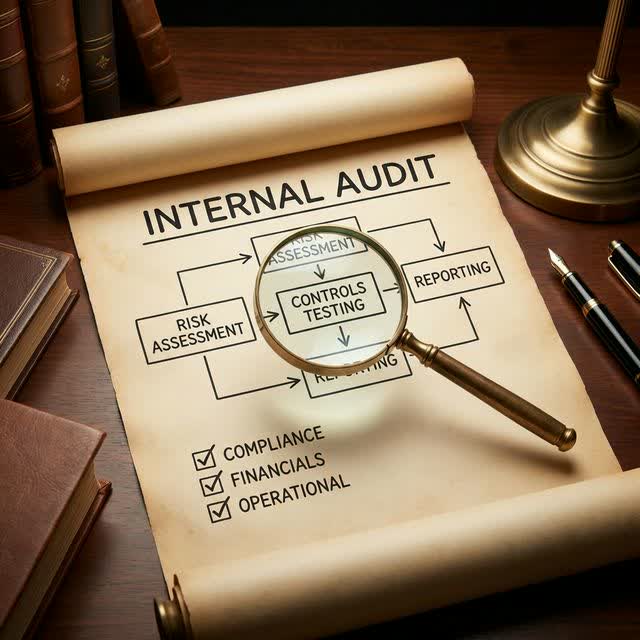
While every audit is unique, the Internal Audit Framework generally follows a standard lifecycle:
1. Risk Assessment & Planning
Before auditing anything, the team identifies the highest risks to the organization. This forms the “Audit Plan.” You don’t audit everything—you audit what matters most.
2. Fieldwork (Execution)
This is the “testing” phase. Auditors will:
- Interview process owners.
- Review documentation and policies.
- Test transactions (e.g., checking if expenses were approved).
- Observe physical processes (e.g., inventory counts).
3. Reporting
The auditor writes a report detailing:
- Observations: What went wrong?
- Risks: What is the impact?
- Recommendations: How do we fix it?
4. Follow-up
Management agrees to an “Action Plan” to fix the issues. The auditor follows up later to ensure the fix was implemented and is working.
Why Do Companies Need Internal Audit?
For publicly traded companies, it’s often a requirement (e.g., NYSE listing rules). But standard private companies also benefit immensely:
- Fraud Detection: Internal controls are the first line of defense against embezzlement and asset theft. (See our guide on Fraud Prevention).
- Process Improvement: Auditors see across departments and often identify inefficiencies that siloed managers miss.
- Compliance Assurance: Ensuring you aren’t violating OSHA, HIPAA, GDPR, or industry regulations.
- Board Confidence: Directors rely on internal audit to give them the “ground truth” about company operations, unfiltered by management bias.
Career Path in Internal Audit
Internal audit is a popular entry point for finance professionals because it offers a “birds-eye view” of the entire company.
- Entry Level: Staff Auditor (0-2 years exp)
- Mid Level: Senior Auditor (2-5 years exp)
- Management: Audit Manager / Director
- Executive: Chief Audit Executive (CAE)
Common certifications include the CIA (Certified Internal Auditor) and CISA (Certified Information Systems Auditor).
Conclusion
Internal Audit is not just about finding mistakes—it’s about protecting the organization’s value and helping it achieve its goals. By providing independent assurance, internal auditors give leaders the confidence to take risks and grow the business.
Related Articles
- Internal Audit Framework: Building an Effective Audit Function from Scratch
- Fraud Detection and Prevention: Internal Audit, Risk Controls, Whistleblower Programs, and Investigation Procedures (2026)
- Welcome to BATO
- Complete Guide to Audit Requirements Worldwide (2026)