The Ultimate Audit Committee Handbook: A 2026 Guide

Of all the subcommittees on a corporate board, the Audit Committee carries the heaviest operational and regulatory burden. Under the intense scrutiny of the SEC, shareholders, and the public, the audit committee is the ultimate safeguard ensuring that a company’s financial reporting is accurate and its internal controls are sound.
Whether you are stepping into a committee chair role for a newly public company post-IPO or revamping the governance structure of an established enterprise, this handbook serves as your definitive guide to executing your duties effectively in 2026.

Part 1: The Foundation of the Audit Committee
The foundation of any successful audit committee relies on two pillars: the charter and the composition of its members.
1. The Audit Committee Charter
The charter is the primary governing document of the committee. It is not a static document; it must evolve alongside changing regulatory requirements (such as new ESG reporting mandates).
At a minimum, the charter must outline:
- Purpose: To oversee accounting processes, internal controls, and audits.
- Authority: The explicit right to hire independent counsel or consultants without management approval.
- Responsibilities: Specific duties regarding financial statements, external auditors, internal auditors, and compliance programs.
2. Composition and Financial Literacy
Under SEC rules and exchange listing standards, the committee must be composed entirely of independent directors. Furthermore, every member must possess “financial literacy”—the ability to read and understand fundamental financial statements.
Crucially, at least one member must qualify as an Audit Committee Financial Expert (ACFE). This is typically a former CFO, controller, or public accountant who understands GAAP (or IFRS) inside and out.
Part 2: The Three Core Responsibilities
The bulk of the committee’s time is dedicated to maintaining the delicate balance of power between management, the internal auditors, and the external auditors.
1. Oversight of Financial Reporting
The committee must review all quarterly (10-Q) and annual (10-K) SEC reporting filings before they are released to the public.
This requires asking management difficult questions:
- Are there any significant changes to accounting policies this quarter?
- What are the most critical accounting estimates, and how were they calculated?
- Were there any disagreements between management and the external auditor?
2. Oversight of the External Auditor
The external auditor reports directly to the audit committee, not to the CFO. The committee is solely responsible for appointing, compensating, and firing the audit firm.
To maintain auditor independence, the committee must pre-approve all services provided by the auditor. If the auditor is hired to perform the financial audit and simultaneously hired by management to perform lucrative consulting work, their independence is compromised.
3. Oversight of Internal Audit
While external auditors focus on historical financial accuracy, internal auditors focus on current operational risks and control deficiencies.
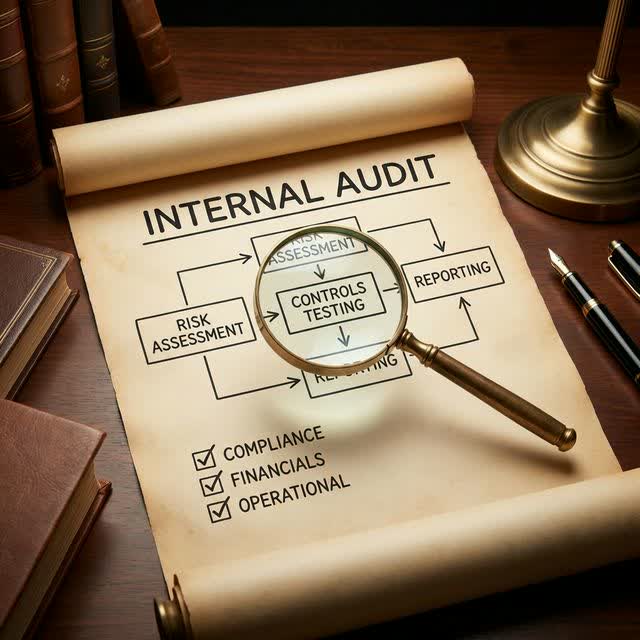
To prevent the CEO or CFO from retaliating against an internal auditor who uncovers fraud, the Chief Audit Executive must report functionally to the audit committee. The committee reviews and approves the annual internal audit plan to ensure it targets the highest risk areas of the business.
Part 3: Emerging Risk Management
In 2026, the audit committee’s role has expanded far beyond traditional financials to encompass enterprise-wide risk.
Cybersecurity and IT Controls
With the adoption of cloud infrastructure and remote work, cyber risk is financial risk. The audit committee often oversees the company’s cybersecurity posture, reviewing penetration test results, ransomware response plans, and the adequacy of IT general controls (ITGCs).
Whistleblower Programs and Ethics
Post-Sarbanes-Oxley, every audit committee must establish robust procedures for receiving, retaining, and treating complaints regarding accounting irregularities. This typically takes the form of an anonymous whistleblower hotline. The committee must ensure that investigations are conducted independently and that whistleblowers are protected from retaliation.
Conclusion: The “Executive Session”
The most powerful tool in the audit committee’s arsenal is the Executive Session—a portion of the meeting held in near-total privacy, without the CEO, CFO, or other management present.
The committee must hold separate executive sessions with the external auditor, the head of internal audit, and the general counsel. This provides a safe harbor for these individuals to raise red flags about aggressive accounting practices or uncooperative management before those issues evolve into catastrophic corporate scandals.
Related Articles
- Management Buyout (MBO): How Managers Acquire the Business They Run
- Executive Succession Planning: CEO Transitions, Emergency Protocols, Talent Development, and Board Oversight (2026)
- Corporate Governance Red Flags: Warning Signs Every Investor Must Recognize
- Executive Compensation and Incentives: Complete Guide to Salary, Bonuses, Equity, and Clawback Provisions (2026)
- Corporate Governance Best Practices: Board Structure, Compliance, and Framework Implementation (2026)
- Board of Directors: Composition, Committees, Duties, and Best Practices for Effective Governance (2026)
Frequently Asked Questions (FAQ)
What is the primary role of an audit committee?
The primary role of the audit committee is to provide independent oversight of a company’s financial reporting processes, internal controls, and independent auditors. It ensures transparency and accuracy in financial disclosures to protect shareholders and stakeholders.
Who should sit on an audit committee?
Audit committees should consist exclusively of independent directors. Furthermore, the SEC requires that at least one member be deemed a “financial expert”—typically a former CFO, controller, or public accountant with an understanding of GAAP and financial statements.
What is an Audit Committee Charter?
An Audit Committee Charter is the foundational document that outlines the committee’s specific purpose, authority, responsibilities, and structure. It must be approved by the full board of directors and reviewed annually to ensure compliance with changing regulations.
How does the audit committee oversee the external auditor?
The committee is directly responsible for the appointment, compensation, retention, and oversight of the external auditor. This includes pre-approving all audit and non-audit services, assessing the auditor’s independence, and reviewing their annual audit plan.
What is the relationship between the audit committee and internal audit?
To maintain independence, the Chief Audit Executive (head of internal audit) should report functionally to the audit committee, rather than strictly to the CEO or CFO. The committee reviews internal audit plans, budgets, and significant findings regarding internal controls.
What are “Executive Sessions” in audit committee meetings?
Executive sessions are private meetings the committee holds without management present. They typically meet separately with the external auditors, the internal auditors, and sometimes the general counsel, to encourage candid discussions about management’s performance and any sensitive issues.
Is the audit committee responsible for cybersecurity?
Increasingly, yes. While some boards have a dedicated risk committee, the audit committee often oversees enterprise risk management, which includes cybersecurity, data privacy, and IT controls to prevent financial and reputational damage.
How often should an audit committee meet?
At a minimum, the audit committee should meet quarterly to review financial results before earnings releases or SEC filings (10-Qs). However, many committees meet 6 to 8 times a year to address risk management, internal audit updates, and special investigations.
What is a whistleblower policy, and why does the audit committee care?
Under the Sarbanes-Oxley Act, the audit committee must establish procedures for the receipt, retention, and treatment of complaints received regarding accounting or auditing matters. This includes an anonymous whistleblower hotline to detect potential fraud.
What happens if an audit committee fails in its duties?
Failure to provide adequate oversight can result in severe consequences, including material misstatements in financial reports, SEC enforcement actions, shareholder lawsuits against directors, and significant reputational damage to the company.