Accounts Receivable Management: Reduce DSO and Stop Cash Flow Leaks
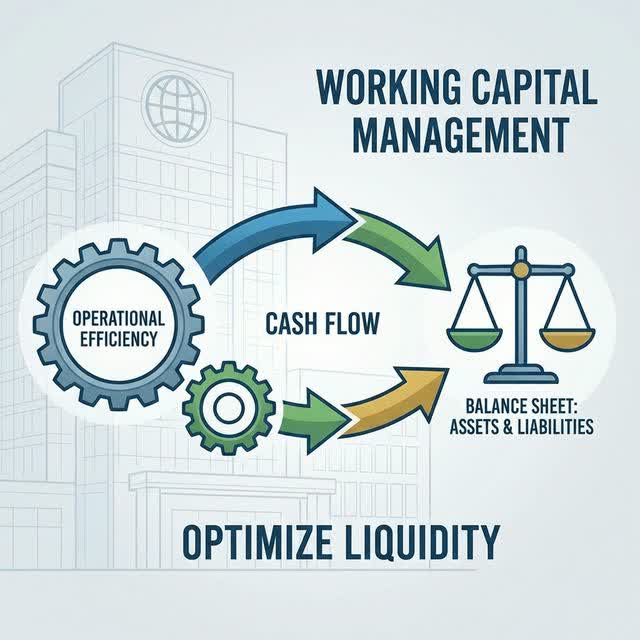
Accounts receivable is one of the most controllable drivers of a company’s operating cash flow — yet most businesses treat it as a passive administrative function rather than an active cash management lever. A company with $20M in revenue and a 75-day DSO is sitting on over $4M in cash that belongs to it but hasn’t yet been collected. That same company reducing its DSO to 45 days would release $1.6M in permanent operating cash — no new customers, no increased revenue, just better collection discipline.
This guide gives you the complete AR management system used by high-performing finance teams.
Understanding DSO: The Core Metric
DSO = (Accounts Receivable ÷ Revenue) × Days in Period
Example: Company with $5M in AR and $40M trailing twelve month revenue:
DSO = ($5M / $40M) × 365 = 45.6 days
This means on average, the company collects payment 45.6 days after invoicing a customer.
Industry DSO Benchmarks
| Industry | Typical DSO Range |
|---|---|
| SaaS / Software | 35–55 days |
| Professional Services | 45–65 days |
| Healthcare | 40–80 days (payer mix dependent) |
| Manufacturing | 50–70 days |
| Distribution/Wholesale | 40–60 days |
| Staffing/Consulting | 55–75 days |
| Construction | 60–90 days |
If your DSO significantly exceeds industry benchmarks, collections processes or credit policy are the likely root cause — not customer quality.
The AR Aging Report: Your Early Warning System
The AR aging report is the most important AR management tool. Run it weekly. The critical question for each bucket:
0–30 days: Current, normal. No action needed unless account has prior history of slow payment.
31–60 days: Beginning to age. Send automated reminder. Flag accounts with no payment arrangement.
61–90 days: At risk. Direct phone contact required. Pause new orders for accounts at this level without a payment plan in place.
90+ days: High write-off risk. Escalate to collections management. Consider referring to collection agency or attorney for balances above $10K.
Target aging distribution for a healthy AR portfolio:
- 0–30 days: ≥75% of AR balance
- 31–60 days: ≤15%
- 61–90 days: ≤6%
- 90+ days: ≤4%
If you have more than 10–15% of AR in the 90+ bucket, you have a collections problem that is eroding your cash position and your reported revenue quality.
Credit Policy: Prevention is Better Than Collection
The most cost-effective AR management happens before the invoice is sent — by setting intelligent credit terms that match risk exposure to customer creditworthiness.
Credit Policy Framework
Tier 1 (Low risk customers):
- Enterprise customers, publicly traded companies, government entities
- Payment terms: Net 45–60
- Credit limit: Determined by volume with no personal guarantee required
Tier 2 (Moderate risk):
- Established private companies with 2+ year operating history
- Payment terms: Net 30
- Credit limit: Based on Dun & Bradstreet or trade credit references
- Consider requiring trade references before extending credit
Tier 3 (Higher risk):
- New customers, pre-revenue startups, sole proprietors
- Payment terms: Net 15 or COD (cash on delivery)
- Require credit card on file as default payment method
- No credit extended until 3+ on-time payments completed
The most underutilized provision: Requiring credit card on file for all accounts under $5,000 in monthly spend. This eliminates the collections problem entirely for a majority of small-balance customers.
The Collections Escalation Sequence
The most common failure in AR management is the absence of a systematic, consistent escalation protocol. Collections improve dramatically when they are automated and predictable:
Automated Dunning Sequence: | Day | Action | Channel | |—|—|—| | Invoice sent | Initial invoice with payment link | Email | | Day −7 (7 before due) | Friendly payment reminder | Email | | Day 0 (due date) | Invoice due notification | Email | | Day +3 | Gentle past-due notice | Email | | Day +10 | Second past-due notice | Email + Phone | | Day +20 | Firm past-due notice with escalation warning | Email + Phone | | Day +30 | AR Manager personal outreach | Phone | | Day +45 | Demand letter, pause account | Certified letter | | Day +60 | External collections referral or legal | Legal counsel |
Setting up this sequence once in an automation tool (Tesorio, Gaviti, or even HubSpot workflows) requires 2–3 hours and dramatically improves collection rates without adding headcount.
The Cash Impact of DSO Reduction
Formula: Cash Released = Revenue per Day × DSO Improvement
| Annual Revenue | DSO Reduction | Cash Released |
|---|---|---|
| $10M | 15 days | $411K |
| $25M | 15 days | $1.03M |
| $50M | 15 days | $2.05M |
| $100M | 15 days | $4.1M |
| $100M | 30 days | $8.2M |
For context, a $50M revenue business reducing DSO by 15 days releases the equivalent of what many mid-market companies carry as their entire operating reserve. This cash is already earned — it just needs to be collected.
Allowance for Doubtful Accounts
GAAP requires companies to estimate the portion of receivables that will not be collected and record it as the Allowance for Doubtful Accounts.
Estimation approaches:
- Historical write-off rate by aging bucket (most common): Apply historical loss rates to each aging bucket. 0–30 days: 0.5%, 31–60: 2%, 61–90: 10%, 90+: 30–50%.
- Customer-specific analysis: For large individual balances (>5% of AR), assess collectibility case-by-case.
Journal entry when establishing/adjusting the allowance:
Dr. Bad Debt Expense         $50,000
  Cr. Allowance for Doubtful Accounts   $50,000
When writing off a confirmed bad debt:
Dr. Allowance for Doubtful Accounts    $15,000
  Cr. Accounts Receivable             $15,000
Conclusion
Excellent AR management is one of the highest-leverage actions a CFO can take to improve cash position without raising external capital or growing revenue. Implement systematic credit tiers, automate your dunning sequence, review AR aging weekly, and calculate DSO monthly. Two to three months of disciplined effort can release millions in permanently improved cash flow — capital that can fund growth, reduce debt, or simply provide the operating cushion that management teams need to make bold strategic decisions.
Related Articles
- Working Capital Management Guide: Cash Flow, Receivables, Inventory, Payables, and Optimization (2024-2026)
- Cash Flow Statement Analysis: What Good and Bad Cash Flow Actually Looks Like
- Working Capital Management: The CFO’s Complete Guide (2026)
- GAAP vs Cash Basis Accounting: Which Method Is Right for Your Business?
Frequently Asked Questions (FAQ)
What is Days Sales Outstanding (DSO)?
DSO = (AR / Revenue) × Days. Measures average days to collect after invoicing. Lower is better. Industry benchmarks range from 35 (SaaS) to 90+ (construction).
What is an AR aging report?
Categorizes receivables by days unpaid: 0–30, 31–60, 61–90, 90+. Target: 75%+ in 0–30 days. 90+ bucket is the write-off risk indicator.
What is a credit policy?
Defines payment terms, credit limits, and documentation requirements by customer risk tier. Prevents bad debt before it becomes a collection problem.
What is an early payment discount (2/10 net 30)?
2% discount for paying within 10 days; full amount due in 30. Annualized cost ≈ 36% — only worthwhile for severely cash-constrained sellers.
What is invoice factoring?
Selling receivables at a 2–5% discount for immediate cash. Effective but expensive (15–60% annualized rates). Best as a short-term bridge, not a permanent strategy.
How does DSO affect working capital?
10-day DSO reduction on $50M revenue ≈ $1.37M in cash released. DSO reduction is often the highest-ROI cash improvement lever.
What is the allowance for doubtful accounts?
A contra-asset that reduces AR to net realizable value. Estimated using aging-bucket write-off rates; recorded as bad debt expense each period.
What technology tools support AR management?
Tesorio, Gaviti, Billtrust, HighRadius for collection workflows; Bill.com, Invoiced for invoicing; ERP AR modules. Biggest single impact: ACH/card payment enablement.
What is AR-based lending (ABL)?
A revolving credit facility secured by eligible receivables (<90 days, creditworthy debtors). Lenders advance 75–85% of eligible AR. Effective cash flow tool for growing businesses.
What are the best practices for reducing DSO?
Invoice immediately, enable ACH/card payments, automate dunning sequences, escalate 60+ day accounts to direct collections, require credit card on file for smaller accounts, offer annual billing to large clients.