Working Capital Management: The CFO's Complete Guide (2026)
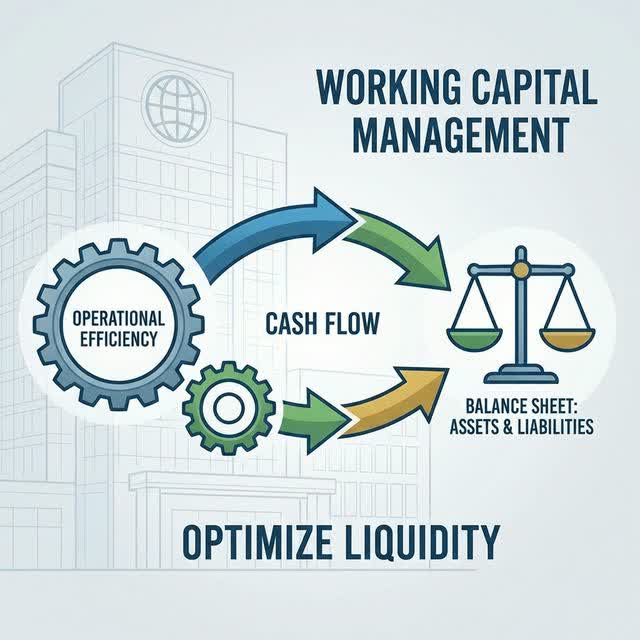
A profitable company can go bankrupt. This seemingly paradoxical statement is the lived reality for thousands of fast-growing businesses that run out of cash despite strong top-line performance. The culprit is almost always poor working capital management.
For CFOs, controllers, and finance-savvy founders, mastering the mechanics of working capital—and specifically the Cash Conversion Cycle—is the difference between a business that scales smoothly and one that constantly teeters on the edge of an emergency bank call.
The Working Capital Formula
Working Capital = Current Assets − Current Liabilities
Current Assets include: cash, accounts receivable, inventory, and prepaid expenses.
Current Liabilities include: accounts payable, accrued expenses, short-term debt, and deferred revenue.
A positive working capital balance means you have sufficient short-term assets to cover near-term obligations. A negative working capital does not automatically signal distress (Amazon famously operates with structurally negative working capital because customers pay before suppliers are due), but for most businesses it signals a liquidity risk.
The Cash Conversion Cycle: Your North Star Metric
The Cash Conversion Cycle (CCC) is the single most powerful metric for diagnosing and improving working capital efficiency. It measures the net time it takes for a dollar of cash invested in operations to come back as a dollar of cash collected from customers.
CCC = DIO + DSO − DPO
| Component | What it Measures | Direction to Optimize |
|---|---|---|
| DIO (Days Inventory Outstanding) | How long inventory sits before being sold | Lower is better |
| DSO (Days Sales Outstanding) | How long it takes to collect after a sale | Lower is better |
| DPO (Days Payable Outstanding) | How long it takes to pay suppliers | Higher is better |
A company with a CCC of 30 converts its working capital to cash in 30 days. A company with a CCC of 80 ties up its capital for nearly three months—requiring either a large cash reserve or an expensive revolving credit facility to sustain operations.
Optimizing the Three Core Levers
1. Reducing DSO (Collect Faster)
Accounts receivable is often the largest working capital drain in service businesses. Tactics to accelerate collections:
- Net 30 → Net 15: Simply shortening payment terms can have a dramatic impact.
- Early Payment Discounts: A “2/10 Net 30” discount (2% off if paid within 10 days) is often cheaper than financing receivables.
- Automated Reminders: Invoice automation tools (Xero, QuickBooks, Bill.com) can send automated payment reminders at Day 7, 14, and 30.
- Credit Screening: Stop extending Net 30 to high-risk customers without deposits or purchase order backing.
2. Maximizing DPO (Pay Slower, Strategically)
Extending time to pay suppliers is free short-term financing. However, abusing supplier terms damages relationships and can lead to suppliers requiring pre-payment.
A sustainable DPO strategy involves:
- Negotiating payment terms explicitly during vendor contract review.
- Using supply chain financing to offer suppliers early payment (funded by a bank at your lower cost of capital) while you pay on 60-day terms.
3. Minimizing DIO (Reduce Inventory)
Excess inventory ties up cash and creates obsolescence risk. Best practices:
- Adopt just-in-time (JIT) inventory management principles where supply chain reliability allows.
- Set re-order points based on accurate demand forecasting rather than gut feel.
- Identify slow-moving SKUs and discount aggressively before they become write-offs that impair your financial statements.
Building a Weekly Cash Flow Forecast
The best defense against a working capital crisis is a 13-week rolling cash flow forecast maintained by the CFO or controller. Unlike the P&L (which records revenue when earned and expenses when incurred), this forecast tracks actual cash movements: when invoices will realistically be paid, when payroll hits, and when supplier payments are due.
A 13-week forecast makes cash gaps visible 90 days in advance—enough time to draw on a revolving credit facility or accelerate collections rather than scrambling for emergency financing the week before payroll.
Conclusion
Working capital management is the unglamorous backbone of financial health. The companies that thrive through rapid growth cycles are those whose CFOs obsess over the Cash Conversion Cycle, maintain rolling 13-week cash forecasts, and negotiate supplier terms as diligently as they negotiate customer contracts. As part of a holistic enterprise risk management program, working capital discipline prevents the most common form of business failure: running out of cash while profitable.
Related Articles
- Working Capital Management Guide: Cash Flow, Receivables, Inventory, Payables, and Optimization (2024-2026)
- Accounts Receivable Management: Reduce DSO and Stop Cash Flow Leaks
- Business Valuation Methods Explained: DCF, Comparables & More (2026)
- Inventory Accounting: FIFO, LIFO, and Weighted Average Explained
Frequently Asked Questions (FAQ)
What is working capital?
Working capital is Current Assets minus Current Liabilities. It measures the short-term liquidity of a business — its ability to meet operational obligations over the next 12 months.
What is the Cash Conversion Cycle (CCC)?
CCC = Days Inventory Outstanding + Days Sales Outstanding - Days Payable Outstanding. It measures how long it takes to convert working capital investment into cash. A lower CCC is more efficient.
What is Days Sales Outstanding (DSO)?
DSO measures the average days to collect payment after a sale. A rising DSO signals customers are paying more slowly, squeezing cash flow.
How can a company reduce its DSO?
Strategies include: early payment discounts, tightening credit standards, automated invoice reminders, electronic invoicing, and requiring deposits from new or high-risk customers.
What is Days Payable Outstanding (DPO) and why do companies try to maximize it?
DPO measures how long a company takes to pay suppliers. Maximizing DPO conserves cash and creates free short-term financing, though pushing it too high can damage supplier relationships.
What is a working capital facility?
A revolving line of credit used to bridge temporary gaps between cash inflows and outflows. You borrow and repay repeatedly within the limit and only pay interest on the outstanding balance.
Can a profitable company have a working capital problem?
Yes. Overtrading (growing faster than cash can be collected) can leave a profitable company cash-starved. The P&L may look healthy while cash runs dangerously low.
What is supply chain financing?
Reverse factoring that allows buyers to offer suppliers early invoice payment at the buyer’s lower cost of capital, while the buyer pays the lender on extended terms.
How does working capital affect a company’s M&A valuation?
Buyers and sellers negotiate a working capital peg at closing. Differences above or below the peg adjust the final purchase price dollar-for-dollar.
What is invoice factoring?
The sale of outstanding accounts receivable at a discount for immediate cash. Effective but expensive (1%–5% of invoice value) and should be considered a last resort.