Equity Compensation and Stock Options: Complete Guide to Grants, Vesting, Taxation, and Accounting (2026)

schema: | { “@context”: “https://schema.org”, “@graph”: [ { “@type”: “Article”, “headline”: “Equity Compensation and Stock Options: Complete Guide to Grants, Vesting, Taxation, and Accounting (2026)”, “description”: “Comprehensive guide to equity compensation including stock options, RSUs, vesting schedules, tax implications (409A, exercise, disqualifying dispositions), accounting (ASC 718), plan design, and equity strategy. Essential for founders, employees, and advisors.”, “image”: “https://bato.com.np/assets/images/equity-compensation.jpg”, “datePublished”: “2026-02-19”, “dateModified”: “2026-02-21”, “author”: { “@type”: “Person”, “name”: “Jennifer Adams” }, “publisher”: { “@type”: “Organization”, “name”: “BATO - Business Audit & Tax Organization”, “logo”: { “@type”: “ImageObject”, “url”: “https://bato.com.np/assets/images/logo.png” } } } ] }
Equity compensation is a critical tool for startups to attract and retain talent while conserving cash. This guide covers equity structure, taxation, accounting, and implementation in 2026.
Startups use equity compensation to compete with larger companies offering higher salaries. Proper management requires understanding how equity grants affect the cap table, navigating complex tax implications (409A valuations, ISO vs. NSO treatment), and planning for liquidity events like Series A fundraising or potential IPO.
- Equity Compensation Fundamentals
- Equity Taxation
- Equity Plan Design and Administration
- Equity in Different Company Stages
- Conclusion
- Resources
Equity Compensation Fundamentals
Types of Equity Awards
Common Equity Instruments:
1. Non-Qualified Stock Options (NSOs)

   Definition: Right to purchase company stock at strike price
   Tax treatment: Favorable at grant (no tax)
   Exercise mechanics: Employee pays strike price to buy shares

   Example:
   - Strike price: $1.00/share
   - Grant: 100,000 options
   - 4-year vesting (25% per year)
   - Exercise price = $1.00 × 100,000 = $100,000 cash at vesting

   Taxation:
   - Grant: No tax
   - Exercise: Ordinary income on difference between FMV and strike
     * FMV at exercise: $5.00
     * Spread = ($5.00 - $1.00) × 25,000 exercised = $100,000 ordinary income
   - Sale: Capital gains on appreciation beyond exercise spread

   Advantages:
   ✓ No upfront cost to employee
   ✓ Favorable tax treatment (capital gains on appreciation)
   ✓ Unlimited grants (no tax limit)
   ✓ Tax-deferred until exercise/sale

   Disadvantages:
   ✗ Must have cash to exercise
   ✗ Spread becomes ordinary income (tax burden)
   ✗ Shares only owned after exercise

2. Incentive Stock Options (ISOs)

   Definition: Special tax-qualified options with favorable treatment
   Requirements: Must comply with IRC Section 422

   Advantages over NSOs:
   ✓ Exercise-to-sale spread NOT ordinary income
   ✓ Long-term capital gains treatment possible
   ✓ Holding period: 2 years from grant + 1 year from exercise

   Example (same grant):
   - Exercise FMV: $5.00, Strike: $1.00
   - Spread: $100,000 (NOT ordinary income)
   - If hold 3+ years: Entire gain = long-term capital gain
   - Tax at 20% = $20,000 vs. $37,000 (ordinary income rate 37%)
   - Tax savings: $17,000+ per $100K exercise

   Limitations:
   ✗ $100,000 annual vesting limit (per IRC 422)
   ✗ Can't exercise early (before vesting)
   ✗ Must exercise within 10 years of grant
   ✗ Employee must exercise within 90 days of termination
   ✗ Alternative minimum tax (AMT) implications possible

   Disqualifying Dispositions:
   If sell within holding period (2year grant + 1 year exercise):
   - Spread becomes ordinary income
   - Defeats ISO purpose
   - Example: Exercise year 4, sell year 4 = disqualifying
             Exercise year 4, sell year 6 = qualifies for cap gains

3. Restricted Stock Units (RSUs)

   Definition: Promise of shares upon vesting (no purchase required)
   Taxation at vesting: Fair market value on vesting date = ordinary income

   Example:
   - Grant: 100,000 RSUs
   - 4-year vest (25,000/year)
   - FMV at vesting year 1: $5.00
   - Income: 25,000 × $5.00 = $125,000 ordinary income

   Advantages:
   ✓ No purchase necessary (automatic share delivery)
   ✓ Predictable value (vesting = ownership)
   ✓ No holding period issues
   ✓ Tax deferred until vesting

   Disadvantages:
   ✗ Tax at vesting regardless of later performance
   ✗ Stock decline after vesting = no tax benefit
   ✗ Always ordinary income (no capital gains advantage)

   Tax Withholding:
   - Company withholds taxes at vesting
   - Employee receives net shares
   - Example: 25,000 RSUs vest, FMV $5 = $125K income
             At 37% tax rate: Company withholds ~46,250 shares
             Employee receives ~53,750 shares, $125K W-2 income

4. Restricted Stock Awards (RSAs)

   Definition: Shares issued immediately but subject to forfeiture
   Taxation: At vesting date (forfeiture risk lapses)

   Less common than options/RSUs (tax disadvantage):
   - Ordinary income at vesting
   - No advantage over RSUs
   - Only benefit: Earlier vesting election (83(b) election)

5. Performance Stock Units (PSUs)

   Definition: Contingent shares based on performance metrics
   Payout: 0-200% depending on achievement

   Example:
   - 100,000 target PSUs
   - Metrics: Revenue growth, profitability targets
   - If 100% achievement: 100,000 shares at vesting
   - If 50% achievement: 50,000 shares
   - If 150% achievement: 150,000 shares

   Tax treatment: Similar to RSUs (income at vesting at FMV × actual shares)

   Advantages:
   ✓ Aligns employee incentives to company goals
   ✓ Lower cost if underperformance
   ✓ Motivates high performers

   Disadvantages:
   ✗ Complexity (metrics, measurement, disputes)
   ✗ Tax uncertainty (actual payout unknown until vest)
Vesting Schedules
Standard Vesting Approaches:
4-Year Vest with 1-Year Cliff:
- Grant: 100,000 options
- Vesting: 25,000 per year (25% annually)
- Cliff: Nothing vests for 12 months
- After cliff: Vesting accelerates (monthly thereafter)

Timeline:
Month 1-11: 0 vesting
Month 12: 25,000 vest (cliff completion)
Month 13-24: 2,083/month (25,000/12 months)
Month 25-36: 2,083/month
Month 37-48: 2,083/month
Month 49: 0 (already vested 100,000)

Rationale:
- Cliff ensures employee commitment (1-year test)
- Departure before cliff: Employee forfeits everything
- After cliff: Retains pro-rata vesting if departs

Departure Scenarios:
Example: Quits month 18 (6 months post-cliff)
- Vested: 25,000 (cliff) + 12,500 (6 months post-cliff) = 37,500
- Forfeited: 62,500 (unvested)
- Can exercise vested 37,500 for 90 days post-termination

3-Year Straight Vesting:
- Vesting: 33,333/year over 3 years
- No cliff (employee vests monthly)
- Less common (cliff is standard for startups)

2-Year Double-Match (Later-Stage Companies):
- Initial: 50% vesting over 2 years
- Tranche 2: Contingent on performance/outcomes
- Used for acquisitions/retention

Custom Schedules:
- Founder vesting: Often longer (4-5 years)
- Later stage: Shorter vesting (1-3 years)
- Refresh grants: New vesting schedules every 1-2 years
Equity Taxation
409A Valuation and Pricing
Why 409A Matters:
Section 409A: IRC provision imposing tax penalty on certain deferred compensation

For startup equity:
- If option strike price < Fair Market Value (FMV): Section 409A violation
- Triggers immediate income tax + 20% penalty + interest
- Example violation and consequences:

Company: Series A funded startup, 409A FMV determined at $2.00
- Manager receives 50,000 options at $1.50 strike (discount to FMV)
- Violation: Strike < 409A FMV
- Immediate tax: $50,000 (50K × $2 - $1.50)) + 20% penalty = $10,000
  Total tax cost: $40,700 (37% ordinary income + 20% penalty)
- Plus: Interest from grant date to taxation

409A Valuation Process:

Required for:
✓ All non-qualified deferred compensation
✓ Restricted stock awards
✓ Stock options with strike < FMV
✓ RSUs / equity awards requiring valuation

FMV Determination Methods (in order of reliability):

1. Arm's Length Valuation (Best)
   - Independent valuation firm
   - Market data analysis
   - Comparable companies
   - Discounted cash flow
   - Cost: $5,000-15,000 per valuation
   - Frequency: Required annually (material changes)
   - Safe: IRS deference presumed

2. Valuation by Trained Appraiser (Acceptable)
   - Less formal than methodology 1
   - Still defensible
   - Cost: $3,000-8,000
   - Acceptable if done competently

3. Reasonable Method (Risky)
   - Company performs valuation
   - Using reasonable methodology
   - NOT recommended (IRS scrutiny likely)
   - Risk: If later audit challenges, penalties apply

409A Timing:

New grant: Must obtain 409A valuation BEFORE or within 30 days of grant
- If grant on Day 30 without valuation: Still OK (safe harbor)
- If grant on Day 31+ without valuation: Violation

Option Strike Price Formula:

For NSOs/ISOs:
Strike Price = Fair Market Value @ Grant Date

Example: Company worth $10M post-Series A
- 409A FMV: $2.00/share
- Employee option grant: Strike = $2.00/share
- Acceptable (strike = FMV)

If company wants to grant below FMV:
- Cannot use options (409A violation risk)
- Must use already-owned restricted stock
- Or grant options at FMV, supplement with restricted stock bonus

Valuation Triggers (When Re-valuations Required):

Required:
✓ Annual (at minimum if no significant events)
✓ After major capital raise (Series A, B, etc.)
✓ After significant business event (acquisition, IPO, financing)
✓ After material ownership change
✓ When previous valuation questionable

Not Required:
✗ Between material events if reasonable periodically reviewed
✗ If valuation clearly conservative (lower FMV = more available for strikes)
Employee Tax Consequences
Detailed Tax Examples:
Scenario 1: NSO Exercise and Sale (Ordinary High-Earner)

Employee: VP Engineering, 37% federal tax bracket
Grant: 100,000 NSOs at $1.00 strike
Vesting: Year 4 (25,000/year)
Exercise: Year 5 (all 100,000 options)
Sale: Year 6

Timeline:
Year 1: Grant at $1.00 - No tax event
Year 2-4: Vesting annually - No tax event (vesting is automatic)
Year 5: Exercise
  - FMV at exercise: $8.00/share
  - Strike: $1.00/share
  - Spread: $7.00/share × 100,000 = $700,000
  - Tax at 37% (ordinary income): $259,000
  - Cash invested: $100,000 (strike price paid)
  - Net cash needed: $359,000

Year 6: Sale
  - Sale price: $12.00/share
  - Total proceeds: $1,200,000
  - Less: Original cost (spread): $700,000
  - Capital gains: $500,000
  - Tax on gains at 20% (long-term): $100,000

Total Tax Paid:
- Exercise spread: $259,000
- Capital gains: $100,000
- Total: $359,000 on $1,200,000 proceeds = 30% effective rate
- Net after tax: $841,000

Scenario 2: ISO Exercise and Sale (Favorable Treatment)

Same facts as above, but ISO instead of NSO:

Year 5: Exercise
  - Spread: NOT ordinary income (ISO benefit)
  - Hold shares for 3+ years (critical)
  - No immediate tax (unlike NSO)
  - Alternative Minimum Tax (AMT) consideration (complex)

Year 6: Sale (within 1 year of exercise)
  - Disqualifying disposition: Spread becomes ordinary income
  - Ordinary income: $700,000 × 37% = $259,000
  - Capital gains: $500,000 × 20% = $100,000
  - Total tax: $359,000 (same as NSO!)
  - Benefit lost due to early sale

Year 7+: Sale (3+ years after grant, 1+ year after exercise)
  - Qualifying disposition: All ordinary income removed
  - Entire gain treated as long-term capital gain
  - Capital gains: $1,100,000 (full spread + appreciation)
  - Tax at 20%: $220,000
  - Total tax: $220,000 (vs. $359,000 NSO) = $139,000 SAVED
  - Net after tax: $980,000 (vs. $841,000 NSO)

ISO Advantage: $139,000 tax savings = significant!
Requirement: Hold shares minimum period (2 years grant, 1 year exercise)

Scenario 3: RSU Vesting and Sale (No Choice)

Grant: 100,000 RSUs at $1.00 strike (grant is theoretical)
Vesting: Year 4, quarterly (25,000 per year)
Sale: Year 5 (all shares in Year 5)

Year 4 Vesting:
- Year 4 Q1: 25,000 RSUs vest at FMV = $8.00
  Income: 25,000 × $8.00 = $200,000 ordinary income
  Tax: $200,000 × 37% = $74,000
  Company withholds ~25,000 shares (net 18,750 shares post-withholding)

- Year 4 Q2-4: Same (repeats 4x total)
  Total income: 4 × $200,000 = $800,000 ordinary income
  Total tax: $800,000 × 37% = $296,000
  Company withholds sufficient shares to cover (employee nets ~75K shares)

Year 5 Sale:
- Sale price: $12.00/share × 75,000 = $900,000
- Cost basis (FMV at vesting): $8.00 × 75,000 = $600,000
- Capital gains: $300,000
- Tax at 20%: $60,000

Total Tax Paid:
- Vesting (ordinary): $296,000
- Sale (capital gains): $60,000
- Total: $356,000 on $900K proceeds = 40% effective
- Net after tax: $544,000

Comparison to NSO/ISO:
- NSO: $359K tax, $841K net = 30% effective
- ISO: $220K tax, $980K net = 18% effective
- RSU: $356K tax, $544K net = 40% effective
- RSU significantly worse due to taxation at vesting (not at exercise/sale)
Equity Plan Design and Administration
Stock Option Plan Setup
Establishing a Plan:
Key Plan Components:

1. Plan Document
   - Board approval (required)
   - States: Grant limits, vesting rules, amendment procedures
   - Contains standard boilerplate language
   - Cost: Template $500-2,000, Custom $5,000-15,000

2. Grant Agreement
   - Individual grant terms
   - References plan document
   - Employee acknowledges terms
   - Specifies: # of options, strike, vesting, forfeiture

3. Equity Register/Console
   - Tracks all grants
   - Tracks vesting schedules
   - Monitors 409A compliance
   - Monitors dilution

4. Board Resolutions
   - Approval of plan
   - Individual grant approvals
   - Plan amendments
   - Documentation trail (important for disputes)

Plan Limits and Mechanics:

Share Reserve:
- Total shares available under plan
- Example: Series A startup authorizes 10M shares
  * 2M granted to founders/early team (2020)
  * 3M granted in Series A (2021)
  * 5M reserved for future grants
  * Total: 10M shares

Common Terms:
- Strike price: FMV at grant date
- Vesting: 4-year vest, 1-year cliff standard
- Exercise period: 90 days post-termination (or longer)
- Acceleration: Full or partial on acquisition/change of control
- Leakage: Dividends (typically not paid on unvested options)

Equity Administration:

Annual Tasks:
✓ 409A valuation (required)
✓ RSU vesting entries (monthly typically)
✓ Exercise processing (as needed)
✓ Termination/forfeiture tracking
✓ Performance stock payout determinations
✓ Reconciliation of option register
✓ Board updates (grants, financial impact)

Stock Option Exercises:

Exercise Methods:
1. Cash payment of strike price (simplest)
   - Employee pays $X (strike × shares)
   - Receives shares
   - Cost: $100K - $500K+ depending on strike/shares

2. Cashless exercise (common for underwater options)
   - Shares sold immediately
   - Broker advances strike price
   - Employee nets difference
   - Example: $8 FMV, $5 strike
             Broker sells shares, gets $8/share = $800K
             Pays strike $5/share = $500K
             Employee nets $300K after taxes

3. Stock trading plan (Rule 10b5-1, public companies)
   - Pre-scheduled exercises and sales
   - Prevents insider trading claims
   - Required 30-90 day setup

Accounting Treatment (ASC 718):

Expense Recognition:
- For all equity awards
- Over vesting period
- Based on FMV at grant date

Example: 100,000 options granted
FMV = $5.00/option (determined by 409A)
Total: $500,000 over 4 years = $125,000/year expense

Income Statement Impact:
- P&L: $125K compensation expense annually
- Balance Sheet: $125K additional paid-in capital
- Cash: No impact (non-cash expense)

Dilution:
- Options/RSUs dilute existing shareholders
- Example: 10M shares outstanding, 2M options granted
  Dilution: 2M / (10M + 2M) = 16.7%
  Post-exercise: 12M shares, 16.7% of new equity goes to option holders

Vesting Tracking:

System Requirements:
- Track individual grants
- Calculate monthly/quarterly vesting
- Identify fully vested positions
- Flag vesting milestones
- Process forfeitures
- Generate reporting for financials

Tools: Carta, Certent, internal Excel/systems
Cost: $500-5,000/year scalable systems
Equity in Different Company Stages
Startup Growth Stages
Equity Strategy Evolution:
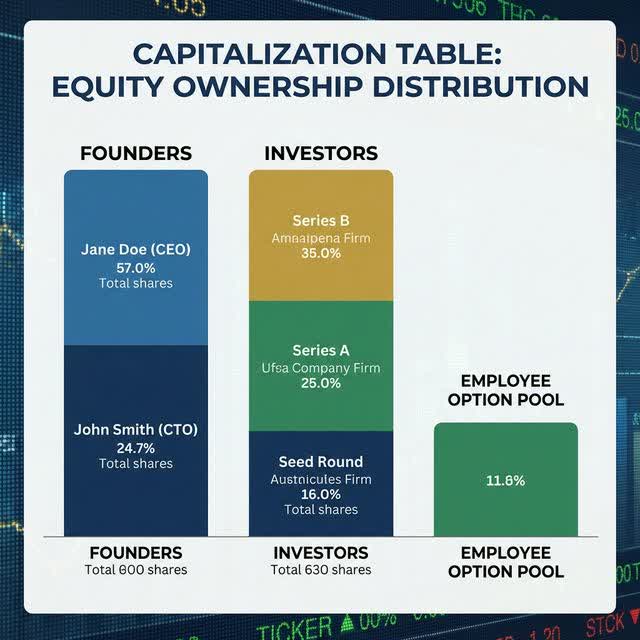
Seed Stage (Pre-Series A):

Equity Levels:
- Founders: 40-50% each (paired founders)
- Seed angels/investors: 10-20%
- Employee option pool: 10-15% (reserved)

Typical grants:
- Early employees (VP/CTO level): 2-5%
- Mid-level employees: 0.5-1.5%
- Junior employees: 0.1-0.5%
- Advisors: 0.1-0.3% (typically vesting)

Terms:
- Strike: $0.01-0.10 (extremely low, company immature)
- Need 409A valuation? Not always (low value companies exempt if <$25M)
- Vesting: 4-year, 1-year cliff standard
- Acceleration: Partial (25-50% on acquisition, not double-trigger)

Series A (Funding Round):

Capital Raised: $2-10M typical
Company Valuation: $8-30M post-money

Equity Refresh Needed:
- After Series A, company worth $20M (example)
- Early options at $0.10 already 200x underwater (free money essentially)
- Problem: Can't motivate new hires with underwater options
- Solution: New option pool granted to new employees at Series A FMV

Employee Equity Mix:
- Founders: 30-40% (diluted from seed)
- Series A investor: 20-25% (new money)
- Employee pool: 10-15% (new grants at Series A strike)
- Earlier employees (seed grants): 5-10% (diluted)
- Option pool reserved: 10-15% (for future employees)

Series A Grants:
- Strong performers from seed: 0.5-2%
- New VP hires: 1-3%
- Mid-level: 0.3-0.8%
- Junior: 0.05-0.2%
- Strike: Series A FMV (with 409A valuation required now)

Series B and Later:

Equity Dynamics:
- More dilution (each round introduces new investors)
- Founder dilution: Each round 20-40%
- After 3 rounds: Founders often 20-30% (from 50%)

Employee Grants:
- Less equity available (diluted by fundraising)
- Higher strike price (company more valuable)
- More common: Combination of equity + cash salary

Retention Mechanics:
- Existing employees: Refresh grants (new pool)
- New hires: Smaller equity grants (less available)
- High performers: Larger grants + cash bonuses

Late Stage (Pre-IPO, Series C+):

Equity Scarcity:
- Company worthing $500M+ (typical pre-IPO)
- Option pool limited (VCs want large ownership)
- Competition: For scarce equity, salaries increase

Share Grants to Employees:
- VPs/Key roles: 0.1-0.3%
- Staff: 0.01-0.05%
- Much smaller grants than earlier stages
- Compensation shifts to cash

Vesting Acceleration:
- More common: Double-trigger acceleration
- Single-trigger (full acceleration on acquisition): Rare at this stage
- Half-trigger: Common (50% accelerates on acquisition, rest on continued employment)
Conclusion
Equity compensation is critical for startup success. Proper planning prevents costly 409A violations, tax inefficiency, and employee disputes. Key takeaways:
Critical Success Factors:
- 409A Compliance
- Annual valuations required
- Timely grant documentation
- Strike price = FMV or risk penalties
- Clear Plan Documentation
- Written plan document (boilerplate acceptable)
- Board-approved grants
- Clear vesting schedules
- Documented 409A process
- Tax Awareness
- Many employees unaware of tax consequences
- Consider providing 409A valuations to employees
- ISO advantage can be significant (but requirements strict)
- RSUs simplest but most tax-burdensome
- Retention & Motivation
- Equity refresh cycles important (especially Series A+)
- Vesting cliffs important (commitment device)
- Acceleration provisions (acquisition motivation)
- Performance vesting (goal alignment)
- Administrative Excellence
- Robust equity tracking systems
- Clear documentation trail
- Regular reporting to board
- Employee education/transparency
Expected Outcomes:
Properly designed equity plans:
- Attract and retain talent (vs. all-cash compensation)
- Reduce cash burn (equity vs. cash tradeoff)
- Align employee incentives with company success
- Enable founder diversification over time
- Support company valuations (investors value employee alignment)
Resources
- Plan Administration: Carta, Certent, Pulley (equity management platforms)
- Valuation: 409A appraisers (national networks, regional specialists)
- Legal Documents: NCSA, LawGeex (template plans)
- Tax Planning: CPA firms, tax attorneys (individual guidance)
- Employee Education: Company handbook, plan summaries (communication)
- Regulatory: IRS Section 409A guidance, IRC Section 422 (ISO rules)