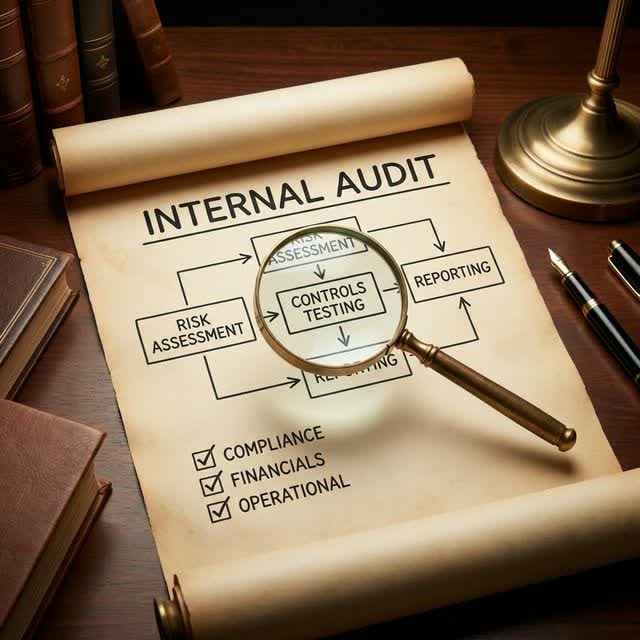
Month-End Close Checklist: 30-Step Controller Guide for 2026
Why Close Discipline Drives Ad Value and Audit Cost
Fast, evidenced closes reduce CPA cleanup, catch Fraud early, and produce reliable Financial Statements for lenders and boards. Slow closes signal weak Internal Controls and inflate year-end audit fees.
This checklist gives controllers a repeatable 30-step close that fits QuickBooks, Xero, or NetSuite and satisfies Audit Procedures evidence standards.
Close Calendar: WD-0 to WD-5 Model
| Day | Focus | Owner |
|---|---|---|
| WD-0 | Freeze + cut-off notice | Controller |
| WD-1 | Cash + AR | Staff / AR lead |
| WD-2 | AP + payroll + expense | AP / Payroll |
| WD-3 | Inventory, prepaids, fixed assets, leases | Controller |
| WD-4 | Revenue cut-off, accruals, tax provisions | Controller |
| WD-5 | Flux, review, lock, reporting pack | Controller + CFO |
Publish owners and due times. Late inputs go to next month with accrual — do not hold the close.
The 30-Step Checklist
A. Cut-off and cash (Steps 1-7)
- Issue cut-off memo: last AP invoice date, AR shipment date, payroll cutoff.
- Lock prior month in system after WD-5; log any reopen.
- Pull all bank/credit-card statements; confirm feed completeness.
- Reconcile every cash account; clear outstanding >30 days.
- Review bank rec discrepancy report; attach support for adjustments.
- Confirm intercompany cash and clearing accounts zero or explained.
- Preparer signs, reviewer signs with date.
See Cash-Flow Analysis and Treasury Systems for controls at scale.
B. AR and revenue (Steps 8-12)
- Age AR; follow up >30 days; reserve doubtful per policy.
- Test revenue cut-off: last 5 shipments/invoices before and after month-end to ASC 606 / IFRS 15 criteria.
- Reconcile deferred revenue rollforward; tie to contracts.
- Confirm subsequent cash receipts for large balances.
- Approve credit memos separately; log reason.
C. AP and expenses (Steps 13-17)
- Age AP; accrue goods received not invoiced.
- Match POs to bills; investigate price/quantity variances — see Procurement Fraud.
- Review employee expenses and CapEx vs OpEx classification.
- Reconcile corporate cards in full; require receipts.
- Confirm subsequent disbursements for cut-off.
D. Payroll and tax (Steps 18-21)
- Tie payroll register to GL and to returns; clear payroll clearing.
- Review contractor payments for 1099 vs W-2 risk and nexus — see Payroll Tax Guide and SALT Planning.
- Update sales-tax liability and nexus tracker — see SaaS Sales Tax.
- Post income-tax provision or estimate; track Filing Deadlines.
E. Balance-sheet substance (Steps 22-26)
- Roll prepaids and amortize; tie to invoices.
- Roll fixed assets, post depreciation, review additions for capitalization.
- Update lease schedules for ASC 842 / IFRS 16.
- Count or roll inventory; reserve obsolescence — see Inventory FIFO/LIFO.
- Reconcile loans, equity, and related-party balances with support.
F. Review, flux, and lock (Steps 27-30)
- Run flux analysis: explain >10% or $ threshold variances vs prior month and budget.
- Controller review meeting: open items, risks, and Audit Committee-worthy issues.
- Issue reporting pack: P&L, balance sheet, cash flow, AR/AP agings, close binder index.
- Lock period, export GL + audit log to archive, schedule post-mortem for delays.
Evidence Standard for Each Step
Every step needs: what was done, by whom, when, with what support, and who reviewed it. Screenshots without tickmarks fail. Use this line at the foot of each workpaper:
Prepared by ___ on ___ | Support: ___ | Reviewed by ___ on ___ | Conclusion: ___
This matches Internal Audit Framework and Q1 Audit Prep expectations.
KPIs to Track
- Days to close (target 3-5)
- Number of post-close adjustments (target declining)
- Unreconciled cash age (target zero >30 days)
- Close binder completeness at lock (target 100%)
- Audit findings repeat rate (target zero repeats)
Report KPIs to the Audit Committee quarterly.
Common Bottlenecks and Fixes
| Bottleneck | Fix |
|---|---|
| Late AP invoices | Accrue GRNI, enforce WD-1 deadline |
| Bank feed gaps | Daily feed check, manual import backup |
| Payroll late | Hard payroll calendar + clearing review |
| No flux | Template with thresholds + owner commentary |
| Reopens | Password lock + CFO-only exception log |
For scale-ups, add Automating AP with AI and CFO Post-Merger Integration controls only after the base close is stable.
FAQ
How long should close take?
3-5 business days for SMBs with discipline. Measure WD-0 to lock, not to reporting-pack polish.
What closes first?
Cash, then AR/AP, then payroll, then technical areas (inventory, leases, revenue), then flux and lock.
Who approves journals?
Preparer ≠ reviewer. Controller reviews staff journals; CFO reviews controller journals and all post-close entries.
Next Steps
- Adopt the WD-0 to WD-5 calendar this month.
- Assign owners and lock rules in QuickBooks/Xero — see QuickBooks vs Xero Controls.
- File the signed binder and export audit log; link the close memo in your Financial Control Framework.